Psychological Impact: The Wives

Gendys Conference 1998.

This conference was set up by the Beaumont Society which began as a support group for men who cross-dress, for erotic purposes, and eventually set up a sister organisation (Beaumont Trust) to support the wives of these men. This is an article presented at their conference in 1998.

Diana opens by recognising the gains made by the “transgendered” individuals, in the last three decades of the twentieth century, but laments the lack of recognition of the impact on their partners, almost invariably, wives. Women who are damaged by their association with the cross-dressing men are generally left out of the “brave and stunning” narratives, to this day.

Diana refers to these men as afflicted by “Gender Dysphoria”. and is keen to assure her audience that she is not intending to censure the men in this community.

G.P.s. were apt to dismiss the experience of the women, caught up in these marriages, who find they do not meet with the same compassion as their “transgender” partner. The impact on the wives resulted, in some 100 cases, in a need for psychiatric care. That’s an estimated 5% of those who contacted the Beaumont Trust! This is likely to be the tip of the iceberg as most woman, who knew the origins of the Beaumont Trust, would be unlikely to seek their support. To give Diana credit she doesn’t fail these women and presents two horrific case studies to the Gendy’s Conference. How I would love to know the response from the men present.

Aitchison lays out the background: The wife’s become some sort of “muse” for their husbands. His intense interest in her stems, not from love, or desire, but from a kind of identity plagiarism or identity theft.

She has plenty of experience of the wives experiences, having taken calls from over 2000 women over ten years. The wives who contact her are, overwhelmingly, shocked, many she describes as “frightened”.

For anyone who wants a detour to explore Peggy Rudd’s story, mentioned above, here is her book. I confess I am not tempted.

We can thank Trans Widow’s voices for challenging the dominant image of the “gender dysphoric” subject. Far from being prey to a debilitating medical condition, many appear to be in the grip of a porn fuelled obsession. Their partners /exes are the collateral damage.

So, why are these wives so defeated and traumatised? This 👇 sounds like living with your stalker, but with no escape. These men are practising a sort of vampirism of the soul. Aitchison describes this mimicry as the commonest complaint from wives. It’s clearly not an aberrant minority.

Mrs A : Case Study 1

First is the example of Mrs A. She discovered her husband wearing her nightgown and impersonating her sleeping position. It was not his first offence, He ignored her efforts to complain, sulking if she attempted to remonstrate with him. She ends up deciding to say nothing.

Like many an abusive husband he tortures her with “mind games” and accuses her of being mentally ill. After this gaslighting she does have a severe breakdown. His quest for an “identity” stripped his wife of hers…👇. She was an unwilling role model.

I am no expert on trans widows but I have seen enough parallels with the treatment of domestic abuse victims (which these women clearly are). One of the common complaints is how galling is the assumption that only the weak would fall prey to these men. It’s the same old “Why didn’t she leave him?”. As Aitchison points out the women don’t, at first, realise what is happening and, by then, they are more entrapped psychologically and, perhaps, financially. How many of these men wait until their wife has children and financially dependent before unleashing their paraphilia on their wife?

This comparison took me by surprise. The breaking down of the wife’s will is compared to the techniques for breaking the spirit of a wild horse.

The wives may not even know they are being subjected to this “shadowing technique” , I once, naively, assuming the husbands were not so vile as to deploy this as a conscious strategy to break their wives’ spirit; I now think they know exactly what they are doing.

This is a form of coercive control likely undetectable to the victim let alone an outside observer. Even worse he may look like a devoted spouse and she appears unhinged and unkind.

Barbara’s Story: Case Study 2

Barbara’s story if even more stark. Barbara is anxious to make it clear this was atypical behaviour. Maybe the ones writing to trans widows voices are atypical or maybe these are the ones who have managed to escape? Can we trust public accounts of wives who remain entombed in these marriages? I suggest the correct approach is extreme skepticism.

Barbara’ story gets darker. Her husbands behaviour emerged after the birth of her second child and only four years into her marriage. He also appropriated her night clothes and informed her there was nothing she could do about it, she would remain married to him for another 31 years despite the end of their sex life,

His domestic abuse wasn’t confined to the psychological abuse he was also violent to both her and her son. He displayed a different side to his daughter thereby ensuring he ruptured the bond between mother and daughter. Naturally he also became preoccupied by pornography.

In another echo of domestic abuse scenarios he made sure to cut his wife off from any potential support avenues. After lying to her sister she would be estranged from her for thirty years. He made sure to perform his role, as a loving husband, in public whilst being cold and distant in private. At the same time he insisted on wifely obedience from Barbara. Of course he was a transvestic fetishist, something he concealed from their children. Some of these men are being platformed by women’s rights organisations to the dismay of Trans Widows.

Eventually, once the children had left home she broke down and finally realised she could leave the marriage. Fearful of him she signed over her share of the marital assets but he still sent threatening messages to her and continued to disparage her as “mentally ill”.

He remains in her daughters life as a grandfather and she has discovered he is taking hormones. Barbara has lost any close bonds with her children, one too damaged and one living in ignorance of her fathers true nature.

Barbara now helps other women in her situation. Many are bewildered and shocked and some discover their husbands secret life after thirty years.

Not all the women who make contact are middle-aged some young women make contact. Like Barbara they have young children. At the same time they fear their experience will not be understood or believed.

I suspect the Beaumont Trust was not likely to have developed comprehensive support for the women subjected to abuse by cross-dressing spouses. The Trust was set up to support wives to, in turn, prop up their husbands and is predicated on their remaining with their husbands.

Original is here:

Wives Experience

For any one going through something similar. There is an organisation available. You will find many similar accounts on this website 👇.

Trans Widows Voices

You can support my work by taking out a paid subscription to my substack or donating below. All donations gratefully received and they do help me cover my costs and also to keep content open for those not able to contribute.

My Substack

Researching the history and the present of the “transgender” movement and the harm it is wreaking on our society.

£10.00

Jan Morris: Conundrum

This started life as two twitter threads, one on Jan and one on his wife. Since Jan’s daughter has recently spoken out (in an article in The Times) I thought I would take the time to turn it into a blog post, or three.

Jan Morris considered himself a “transsexual” and was treated as a national treasure until his death, earlier this year. Because his name kept cropping up in “trans” world I decided to read his memoir “Conundrum”. It was quite a revelation. I had seen quite a lot of praise for Morris, from feminists, and assumed they had not read his book. On this I was wrong. My thread drew a series of outraged replies from a blue tick feminist / journalist who found my thread “patronising”. It turned out the journalist in question had interviewed Morris. A fact I was not aware of, at the time. I have never found the interview. She ended with the (not at all patronising) suggestion that I simply was unable to recognise good writing and clearly had not read as much on the topic as she, ouch! 😂. In fairness to her, many of us did not know how to spot the signs of autogynephilia and many of came out of the #BeKind stable until we realised the cost, to women’s rights.

The book begins with the usual, ret-conned narrative, that he always knew he had been “born in the wrong body”. If you have read as many of these narratives as I have this is a familiar strategy. I say “strategy” because it is an attempt to deflect from the real route to “transsexuality” for heterosexual men; by which I mean autogynephilia.

Later on Morris makes a bid to be regarded as a “true transsexual” distancing himself from the notion he was cut from the same cloth as transvestites or that his “gratification” takes the same form. He also distances himself from homosexuals, of which more later. j

Just for emphasis. Jan recognised no pruriency to their condition. An emphatic denial of a sexual motive is not uncommon. Even when that sexual desire is turned inward and you, yourself, are the object of your erotic fantasies it is still sexually motivated. Autogynephilia seems a reasonable assumption to make about Morris.

We travel with Jan through the male world he inhabits. He describes his attraction to the “feminine principle” and assigns women the traits of gentleness, forgiveness, giving and, of course, helpmate status rather than leadership. Our Jan is quite the sexist.
But #BeKind

He shares a rather weird anecdote about the school matron who undressed in front of him for reasons that were unclear, perhaps to check a lump on her breast. Completely inappropriate behaviour but Jan sees this as evidence she saw his feminine essence. Of course it could be fantasy, there is now no way of verifying it at this stage.

In his confusion he wondered if every boy wished to be a girl and it is clear he has put women on a pedestal. He has clearly missed large swathes of biblical, historical and literary pronouncements that see women as the source of all sin. He shows a paucity of understanding, or interest in, women’s lives and history; we exist only as the male fantasy he cherishes.

We learn that Jan’s earlier sexual encounters were with males. I would suggest it is significant that he mentions being “flogged” by one the week before and that he preferred to “play the role of girl”. A pre-internet version of “Sissy Porn” ?

This is also a revealing excerpt about those early homosexual encounters. He revels in his beauty and playing the “girl” role whatever that means to Morris. A passive recipient of his fellow male advances seems likely.

Jan then talks about his envy of the female role in procreation which he sees as more fundamental and closer to the life cycle. Recognising he could never be a mother he describes Fatherhood as the next best thing. He also craves the company of girls yet craved for a “man’s love”. Indeed he writes with great sensuousness about a love affair with Otto, only to be crushed, he claims, by Otto wishing Morris was a woman.

More than once Jan reflects on what it means to claim womanhood and to claim to think like a woman. His later pronouncements show he thinks like a man, who “others” women to create a refuge for himself. He creates a prison for women to satisfy his own needs.

Jan was able to find much to celebrate about his maleness. Like a lot of late transitioners he had a degree of prowess in pursuits he only associates with males. Women, he states, cannot claim to feeling this way about our bodies. A man telling women about our bodies. Shocker! {At the risk of feeding the lie we are all biological essentialists, I will just add, that I have never been as aware of the power of a woman’s body while giving birth}.

The context for this immense self satisfaction is a successful assault on Mt. Everest. Jan takes a rather paternal tone he as he condescends to describe this feeling to his “women readers”.
Women! Climbing MOUNTAINS! Heaven Forfend.
We might break a nail.

Quite a paean to masculinity, for a man who has always known he is really a woman. Is mastering womanhood just another tempting summit! once you have assaulted the worlds greatest peak maybe the next one is #PeakTrans?

Apparently women are not team players so it takes males to mount a successful expedition. Odd isn’t it that a man who think women don’t have any solidarity aspires to join the “sisterhood”. He has no idea about the strength of women, when we work together, because he never experienced it.

Next is a revealing lament for the disappearing stiff upper lip and the trend for men showing weakness. He is also not keen the breaking down of barriers between the “genders” . He is not keen on mixed sex expeditions and slyly notes no mission will ever be as successful as his. The All Male one.

There follows a lot about meeting his wife who deserves her own thread. I will return to him age 35. Married with children and preparing to embark on “transition”. Here’s Elizabeth, his wife, eventual a kind of Trans Widow but, he tells us, a “loyal” companion after divorce.

Following the death of a daughter he begins to experiment with hormones. This is a common narrative from these men who centre themselves when there is any danger of attention being focussed elsewhere. His wife would also have been dealing with this bereavement but Jan is focused on himself. He’s “despairing” , he tells us, this was the worse period of his life. Something tells me it wasn’t a barrel of laughs for Elizabeth either.

Interestingly what seems to trigger a lot of resentment about his situation is his exclusion from women only spaces. Notice that when we hear about women it is always how they gratify his need to be recognised as “feminine”. “Cisters” are there to serve our new “sisters”. He began to hate his connection to the male sex and dreaded the absence of women but was gratified when female associates validated his “femininity”.

This theme is fascinating. Men are associated with the public sphere and women with the private sphere. (Sound familiar?) The Ministers & The Ambassadors office bore Jan. He yearns for access to the inner world of females of which more later.

Jan, I think, recognised he has reached the summit of his ambitions as a man. He is by now quite successful. He turns his back on worldly success, which he equated with maleness. He is going to retreat to impotence, which he associated with being a woman. Thanks Jan.

Woman as a de-sexualised, passive member of society is what he aspires to…more of this in the post I will do about Elizabeth.

He would father three (surviving) children with Elizabeth and is living, en famille, in bliss in Venice. He relays an encounter with a blind, destitute, beggar woman to whom he was in the habit of dispensing charity. She has a walk on part in Jan’s fantasy and her only role is to sense the woman in him.

Elizabeth, rather magnanimously, we are told, is Jan’s supporter as he begins to embark on what he thinks of as “change of sex”. I wonder if anyone asked her? Or interviewed her?

Jan then turns to his own assessment of what makes a woman. He lists body parts, chromosomes and hormones and psychological sex. You can guess which he prioritises in order to force his way in to the category to which he does not belong.

“Sex is merely the tool of gender” . Jan wants an identity so “brace yourself I’m coming in” …like a crap version of foreplay, in he comes.

No more sexual favours for Elizabeth as he blithely informs us. On the bright side (for Jan). Life looks brand new. He is getting closer nature & talking to flowers. Women as the quivering sex but also simpler, closer to nature.

Jan reflects that living in female role results in being patronised / ignored and no longer being presented with the bill. I find it noteworthy that he makes a point of saying waitresses frequently gave the bill to Elizabeth which suggests an element of competition about being “more womanly” than she. (A similar competition was noted in a prominent AGP male who makes a cloaked difference at his menopausal wife and how he now boasts more “female” hormones than his wife). Also notice he comments how the “motherly” waitresses have lower expections in terms of tips. Would any other men get away with this rank sexism?

At other times Jan seems not to have understood the #MeToo movement. It’s not supposed to be “me too” can I have some of that! On more than one occasion he welcomes attentions women fight, sometimes a losing battle, against.

Clearly Jan had no intention of joining the militant feminist wing of womanhood. More comfortable in the Surrendered Wives branch of the Barbara Cartland Party.

Here he rather offensively claims his post surgery self was akin to a woman post hysterectomy. Oh the irony. So many TRAs claim GC/Radfems are reducing women to their reproductive parts..Seems this may have originated in the Granddaddy of TS In the UK. 👇#WombEnvy. None of these men seem to understand basic biology and realise that the last thing the surgery grants them is a vagina.

Along with a load of sexist claptrap about how much more womanly he is post transition there’s this corker. Actually talking about women with penis envy and why we are right to be so!!!!
Sexism on Steroids. And maddeningly so call feminist orgs. are yielding!

Honestly I think this book is being used as a training manual for TRAs about what to claim to feel as a woman. 👇. Woman as incompetent, weak, gossipy, focussed on the domestic sphere etc. Women aren’t Stepford Wives. FFS.

And

Women as children!

He throws transvestites under a bus by talking about the quiet thing outloud. Transvestic Fetishism. This now comes under the Trans Umbrella. Our politicians have no fucking idea what they are unleashing on women. Men who get off on hiding a penis in women’s clothes/spaces. 😡

I will return to Jan Morris’s book to cover what we can glean about the life of Elizabeth and his daughter.

You can support my work by taking out a paid subscription to my substack or donating below. All donations gratefully received and they do help me cover my costs and also to keep content open for those not able to contribute.

My Substack

Researching the history and the present of the “transgender” movement and the harm it is wreaking on our society.

£10.00

Stephen Whittle: Q & A: Gender

Future of Gender: Part 3 : Q & A

This post covers the Q & A section of a talk given by Professor Stephen Whittle, at Durham University in 2015. We pick up the talk at 59:22.

This will be added to my series on Whittle which you can find here:

Stephen Whittle

You can watch the YouTube of Whittle’s talk here:

The Future of Gender

The first question relates to this book by David Valentine:

The book is based on ethnographic research looking at mainly MTF (Male to female “transgender” people) who he sought out in the drag balls, clinics, bars, support groups and cross-dressing organisations.

The term “transgender” was gaining currency in social settings but also in policy, medical terminology and the legislative context.

Nevertheless there was some resistance to the term “transgender” from the people Valentine encountered, in the nineties; people who preferred to be identified by their sexual orientation and not their “gender identity”. 👇

Whittle is asked if David Valentine is correct that the use of the term “transgender” creates implicit hierarchies, based on race and class.

Whittle chooses to answer the question in terms of the desire, and ability, to pass as the opposite sex, should you wish to do so. She makes an interesting observation on how liberating the computer was in allowing you to pass as the sex you wished you were. On-line “we were who said we were” . A lot of this movement is fostered by the dis-embodied lives of the internet generation. The problem arises when you take your fantasy into real life and demand that it be allowed to trump reality. Nevertheless, Whittle adds, the debate has moved on and “trans” people no longer aspire to “pass” or blend in with normative body types; because the expectation that “trans” people should disappear was “the most oppressive thing that ever happened to us”. My response: Expecting women to accept an obvious man in our single sex spaces is “the most oppressive thing that ever happened to women”.

Whittle follows this up celebrating how many “trans” people there are now in the world; how the smart phone has brought them into our living rooms and trans activists are spreading all over the world. I can think of no other condition where we would celebrate a group of people who are going to be dependent on #BigPharma for life.

The next question comes from an American who ask a question about medical focused on replicating “cis-bodies” . He /She is from the U.S where you can “buy whatever” and he wonders how Whittle feels about bodies “outside the binary”. Whittle gives a rather surprising answer to this, explaining the limitations of achieving a male body for a “trans” man and how she had to reconcile to that difference once she removed her clothes. She now looks on with alarm (this was seven years ago) at people taking flaps of skin from their arms to construct a facsimile of a penis; with all the limitations in terms of sexual function. She even goes so far as to question clinicians “Why are you doing it on kids?”

On “tran women” she is even more blunt.

Whittle elaborates on this theme admitting that there is a lot of denial/self-deception about surgical outcomes. It’s worth sharing these statements in full:

Whittle also points out that our bodies are not like flat pack IKEA furniture, something Mary Harrington calls this treating our bodies as “meat lego”.

Whittle recounts tales he has heard from mother’s who had sons left disappointed at the outcome of the surgeries and its failure to deliver the new life /girlfriend anticipated. Whittle admits a desire to be blunt about these facts and encourage more realistic expectations; though the message is somewhat undercut with the next bit about how having unrealistic dreams can be enjoyable, nevertheless.

There follows a question about how racism was tackled and the use of an essentialist position about race, as a political strategy, even though nobody really believes an essentialist position about race. Whittle is asked how that compares to the politics of “gender”. Whittle talks about how the aim should be that we don’t see “race” anymore. Then she makes an analogy with gender and the gender based violence perpetrated against you because you are a girl, or a boy. (Whittle thinks “gender” creates this violence). Whittle is not explicit about an exact political proposal but the inference is things should get better for females, and males, if we didn’t see “gender”. This ignores the fact that the kind of violence females are subjected to is, frequently, sexual violence, i.e. because of our biological sex. If we pretend sex isn’t real then we can’t see sexism and it’s naive to think this would eradicate sexual violence. Yet, at 1:17 Whittle admits they don’t even know what “gender” is.

The next question is about Facebook and their 51 gender identities. During this exchange we learn that Whittle was involved in the Facebook consultation and personally added six of these “gender identities”. As part of their answer Whittle talks about finding two women with a different style of clothing and, if he asked them to swap clothes, they wouldn’t because “it just isn’t me”. He then makes it clear that he thinks these different styles of dress are different “genders”. Whittle then claims the ability to spot 8 different woman genders based just on looking at women’s outfits! Also she finds it harder with men because their clothing is more. boring; making it abundantly clear he thinks “gender” is your sartorial choices. In the next breath, she says, if you have 51 genders it becomes meaningless and a civilised society will just get rid of the idea of “gender”. I agree we should get rid of the notion of “gender identity” and understand that we are shaped by the treatment we receive as a result of our biological sex and our behaviour, to some degree, is predicated on our biological sex. This does not mean we fit neatly into sexist stereotypes or that women should be limited by our biology, neither can we simply disregard that female bodies are different.

Whittle then talks about cultures that have more than one “gender”. There are, indeed, different cultures that accommodate men, usually gay, by the idea of a different kind of male/gender. These may be a benign way to include gay men. There are less examples of similar accommodations for females. The ones I have found are in societies hardly liberating for women. There are cultures that allow a girl to be treated as “male” if there are no sons in the family. This does not remedy the general position of girls in these societies, instead, it allows the societal structure, which renders girls as less desirable, to remain intact. Similarly societies which allow widows to don a “male” identity to provide for her family. The status of women doesn’t change and, in fact, this exception props up the existing sex hierarchy. See “Bacha Posh”

Or the Burnesha of Albania. 👇

Final question is about the different generations of “trans” people with different understandings of what it means. Does this have implications for the cohesion of the community?

Whittle answers with, firstly, that nobody needs to know your gender and most of the time you don’t need to know what sex people are. He thinks we are obsessed with knowing if you are men, or women, male or female. He adds an anecdote about having to produce documentation showing that he was a woman.

This final statement exposes the regressive nature of this cult. Whittle seems unable to imagine a world where a woman demands to be able to do anything irrespective of her sex. Instead “trans” is envisaged as a liberating project if, crucially, you repudiate your sex. Whittle seems to think the only way a woman can conceive of an occupation which is not “traditional” for women is by identifying out of your sex.

How about a world where women can aspire to transcend societally imposed restrictions, for women, and still own their sex? That would be progressive. Instead, Whittle, seems to live her life as if the only way she could love other women and storm the citadel of male domination is pretending to be a man.

You can support my work by taking out a paid subscription to my substack or donating below. All donations gratefully received and they do help me cover my costs and also to keep content open for those not able to contribute. (I will add other methods as soon as I have figured it out. 😉)

My Substack

Researching the history and the present of the “transgender” movement and the harm it is wreaking on our society.

£10.00

Stephen Whittle: Future of Gender

Part 1

This post covers a talk given by Professor Stephen Whittle at Durham University in 2015. It’s quite a long talk and there is a lot to cover so this is part 1.

This will be added to my series on Whittle which you can find here:

Stephen Whittle

You can watch the YouTube of Whittle’s talk here:

The Future of Gender

In the brief introduction Whittle’s achievements are listed and the fact that he advises governments around the world as well as the Council of Europe, European Union and The European Commission; bear this in mind when you listen to some of the more outlandish statements.

Whittle begins with an anecdote about how the concept of “gender” was explained to their four year old son, by Whittle’s wife, a nurse. He asked his parents how they know the twins were girls. This was the answer given to him:

Many years later Whittle overhears this same son passing on the same explanation to a friend and comments “we trained him well”. Whittle then elaborates on the process of sex determination by adding this explanation:

Next people with disorders of sexual development (DSDs) are pressed into service, to prop up gender identity ideology. At the risk of repeating myself, DSDs, do not mean anyone is born without a sex, we are a sexually dimorphic species. We are all either male or female.

Whittle anticipated the audience may be confused that she is questioning the Future of “Gender” when her whole life has been a quest to live as her “Gendered self”. So, why is she? The concept of “gender” ,she explains, has only a recent history. She then asks if Gender a matter of being “male” or “female”? Apparently the answer to that question is “no” because we also categorise animals as male or female but we don’t call them “girls” and “boys”. Well, we wouldn’t, would we,because this is the terminology for human beings. Apparently, this is because, according to Whittle, we don’t think dogs have a gender identity. (Conveniently overlooking that we do have words to differentiate the sexes in the animal kingdom).

Whittle then argues this is because “gender” is not “biologically related” and the gender you have is something separate from being biologically male or female. The next question is to ask if being male or female is socially constructed. Whittle says “possibly” and we will come back to this. He then asks if “masculine” and “feminine” are culturally determined. Apparently this is worth looking at in some depth so, Whittle promises, we will come back to it.

Whittle then examines whether we are defined by our hormones /chromosomes and then throws out a question to the audience asking if anyone knows what their chromosomes are. Predictably people don’t know. Whittle asks why we are defining humanity by our chromosomes when nobody knows what they are? This is a ludicrous argument. The number of people with chromosomal abnormalities is a tiny proportion of the population. Additionally, routine karyotype tests, to check for chromosomal abnormalities, at gender clinics, were abandoned; because they are not a feature of the referrals to such clinics. 99% of people can be correctly sexed with a simple observation of our genitalia. Whittle uses this argument to question one of the fundamental organising principles of society, based on biological sex. Our sex doesn’t always matter but sometimes it does; this could be for health reasons where your biological sex is a predictor of risk for certain health conditions; or where symptoms present differently in males and females. It matters for single sex spaces so women have safe spaces from the sex that commits 99% of sex offences.

Whittle uses this same argument to question the case of April Ashley, a male, who had his marriage annulled; because same sex marriage was illegal in the U.K at the time. Ashley had never tested their chromosomes, had removed their male genitalia and taken synthetic “female” hormones for decades. Whittle uses this argument to cast doubt on April’s sex to shore up her insistence that “gender identity” should take primacy over “sex”. She does this by casting doubt on the definition of biological sex and implying that April is a woman because their self-identity should take precedence over biological reality.

At 11:30 minutes in Whittle pokes fun at Civil Servants trying to establish if a Civil Partnership for same sex couples can be annulled on the grounds of non-consummation; ultimately they decided it couldn’t. This was because they could not decide which sex act would have to be performed to establish consummation. Whittle paints herself as the rational voice educating the stuffy Civil Servants. She also claims that she had to educate the Civil Servants on the consequences of the Gender Recognition Act which, in effect, allowed marriages for same sex couples, providing one had a Gender Recognition Act. I am not persuaded this happened.

Whittle then asks if “Gender” is a matter of attribution i.e. is it when we call our children our son or daughter that we somehow define their gender? This argument is, once again, intended to undermine the reality of biological sex and Whittle used her own situation to explain how this is flawed because:

The next consideration is to ask if “gender” is a matter of psychological differences. She doesn’t elaborate.

Whittle then argues that there are journals across the sciences, the natural sciences, biochemistry, psychology and even English Literature publishing hundreds of articles discussing “gender”, because it has become a profoundly important question. This question is only of importance to the navel-gazing, gender identity ideologues. Whittle then makes a joke about how it keeps people, invested in Gender Studies, in work. She is not wrong.

I am not going to lie the calibre of this talk is making me lose all respect for the Professorial class! Next Whittle says we have got the issue “arse about face” and proceeds to ask if anyone in the room fancies David Beckham. He assumes someone does, which is a fair assumption, but then she goes into the realms of gender woo woo.

I am going to go out on a limb here and say it’s reasonable to assume David Beckham has a penis and the discovery he had not, or had female genitalia, would be a deal breaker for heterosexual women, or gay men. It’s this kind of rhetoric that leads to confused teenage girls assuming gay men would be attracted to them. Exhibit A 👇 (Our kids really believe this).

And

In case it’s not clear Whittle thinks “gender presentation” drives sexual attraction. “Nothing whatsoever to do with their body”!

Bearing in mind Whittle is talking in 2015, the very year Stonewall added the T to its remit. 👇

Part two makes it clear Whittle knows the statistic about the sexual abuse women face and she still thinks abolishing single sex spaces is morally acceptable.

You can support my work by taking out a paid subscription to my substack or donating below. All donations gratefully received and they do help me cover my costs and also to keep content open for those not able to contribute. (I will add other methods as soon as I have figured it out. 😉)

My Substack

Researching the history and the present of the “transgender” movement and the harm it is wreaking on our society.

£10.00

Stephen Whittle: 2022

This is an interview that Stephen Whittle gave two weeks ago. I am going to cover it as part of my series on Whittle because it contains a very different narrative than the one I have heard recounted before. The rest of the series is here: 👇

Stephen Whittle

The interviewer begins by asking Whittle to share their back story. Whittle paints a picture of two parents who were immediately “affirming” and in fact had always known. This was the way her mum is alleged to have responded. This was in 1973.

While coming out to her mother her father walked in the room and he too was completely unfazed. Again, I am just going to point out this was in 1973.

Contrast this with what Whittle said about his father in this, 2007, interview in the Guardian:

2007 Interview

Or, consider what Whittle had to say about her mother, seven years ago, at Durham University.

You can find this quote at 12 minutes 48 seconds into this YouTube. (Which I will do a piece on because it’s full of WTF moments).

{I am pretty sure I have heard Whittle talking about years of estrangement from her parents and I will add if I can verify and locate the source.}

Stephen Whittle at Durham University

For the next bit I could use some Lesbians who were at the Women’s Liberation Conference in Edinburgh to comment. Whittle describes realising they didn’t fit in when the women circle danced naked in the evening; to much audience laughter. Whittle explains it was in that moment they knew this was not who they were. The decision to come out as a man was made and, the way Whittle tells it, all the feminist /Lesbian women were unsurprised and supportive; rallying round and finding “him” men’s clothes to pass on. One of the women even knew a “transsexual” they could introduce to Whittle; this was Carol Steele who I covered here:

Carol Steele: Trans Britain (Part 5)

This meeting proved fortuitous and together Whittle and Steele set up a support group for “trans” people this would become Press For Change. Whittle talks a lot about how they were involved in the Gay Switchboard and how they had fantastic support from Gay men. (As we will see in my next piece she, and the T more generally, repaid this by denying same sex attraction was based on the SEX of the person. This is betrayal of the highest order).

Whittle then talked about what tremendous support she had from Manchester Metropolitan University (then a Polytechnic), her employer, to socially “transition” at work. There appears to have been zero opposition at work, according to Whittle’s account. The interviewer then prompts Whittle to talk about the hard times (lest things get too upbeat) and Whittle duly obliges, revealing all the times they lost employment when forced to show their birth certificate. She also claims this was often accompanied by accusations of paedophilia and maintains this is what happens today when anyone expresses support for “trans children”. I am going to go out on a limb here and say these are prepared taking points.

Whittle describes how they studied the law, at night school, to enable her continue the journey to “transition” by living as a “man” while a student. She also realised the law could be used to further the strategic aims of the “trans” community. They looked for suitable test cases and Whittle talks us through the various legal victories, obtained by Press For Change, and some of the losses. Whittle failed to obtain the right to be recorded as the “Father” for the four children had by her wife, Sarah. At the same time, Whittle explained they always “spun” the losses as victories; which is an ongoing strategy. See this comment on Stonewall by Akua Reindorf 👇. This is from a report into Essex University who had de-platformed female speakers with “gender critical” beliefs. Essex University were found to have followed guidance from Stonewall, who train organisations, not on the law, as it is, but how they wish it to be.

Even more astonishingly, about the 30 minute mark, Whittle makes this claim either without a shred of self-awareness or as a deliberate falsehood.

In 1996 London Pride were persuaded to include the T and Whittle talks about taking the children who were entertained by a trans-identified male, Fay Presto, who was also a magician. (You can find fascinating documentaries about Fay Presto on YouTube). In 1997 they had their first stall at the Labour Party conference and Whittle shows a picture which includes Mo Mowlem and Cherie Booth (QC and wife of Tony Blair).

Whittle then describes how she set up a network of FTM (Female to Male) “trans” people and began sending out a regular newsletter which reached 4000 people before it ceased. The BBC also began showing documentaries about FTM people, called The Decision Make Me a Man. Whittle describes them as documentaries “we” made which suggests collaboration with the BBC commenced at least as early as the 90’s.


Next up Whittle reveals his psychiatrist, who was assessing his suitability for medical transition, told him he had not been approved. Whittle leaves the session in despair but tells this tale about what happened next. 👇

This anecdote serves as a useful jumping off point for Whittle to criticise the gatekeeping / safeguarding involved in a medical pathway and call it fundamentally flawed while promoting “trans” led health care. It is also an opportunity to promote the Manchester “Gender Identity”service that no longer requires any psychiatric assessment to access the medical pathway.

There follows a revealing discussion about Press For Change working with Government departments, Civil Servants and Ministers to draft the Gender Recognition Act. Whittle encounters some questioning from a Civil Servant and in walks David Lammy, the Minister responsiblefor getting the GRA into law. Here Lammy is painted as giving Whittle carte blanche.

Now to the “Culture Wars”

I typed this as I was watching and my fury is only matched by my incredulity at Whittles disingenuousness, which, at times, tips over into brazen, outright, lies.

The interviewers brings up the shocking “anti-trans” backlash happening in the U.K. This is how a defence of women’s rights and against the sterilising of children is framed. (Starts from 40 minutes in). Whittle, correctly, identifies the moves to try to allow any man to self declare a woman, and vice versa, as the trigger for women’s resistance. Whittle cites Ireland as the exemplar; and claims there have been no problem; which is wilful ignorance on her part. (See Barbie Kardashian).

Whittle also claims the “links” between women’s groups and the “Proud Boys” are only now becoming clear. (This is a reference to a alleged member of the right wing, Proud Boys, group who had a selfie taken with Posey Parker who had no idea who he was. Plenty of politicians have been caught out this way). Whittle believes the government are stoking a culture war to distract from issues of corruption, which they may well be, but there are plenty of left wing, trade unionist, women leading this fight. Whittle ignores those.

She then goes onto mock women’s fears about men in our intimate spaces; adding the threat that if we don’t want men in our intimate spaces we can have women, like her, back in the female loos. Now she is attacking crowdfunding which has allowed women to legally, defend our rights. What a patronising ar**! She is now saying naive people have been persuaded to give money to causes they don’t properly understand! Now she is mis-characterising the argument saying women think children are being given sex changes at the age of 12! Actually we oppose children being given puberty blockers at age 10. Fact! Teenage girls are getting double mastectomies in the U.K. Granted the age range is not as low as in the United States, where cases of thirteen years old girls getting these surgeries have been documented. Now he is alleging three million pounds have been poured into these legal cases and nobody knows where the money has gone! (Is there some confusion here with the Good Law Project who have been criticised for their fundraising strategy?)

Now she is acknowledging the social contagion element of females in flight from their sex but claims that the Gender Clinics would see these girls and explain why they are not “trans”. This after she has argued that “we know who we are” and psychological assessments are not necessary.

Jesus! Whittle is now acknowledging there are category errors happening with girls thinking they are trans and that she wants to be able to have that conversation but the hysteria around the topic means they are not allowed to! #NoDebate came from your side Whittle!

Now Whittle is disputing claims of issues with trans-ID males and patterns of criminality. She claims there has only been one incident of a pre-op “transwoman” exposing their penis to women and it was someone having a psychotic breakdown, who was mortified by what they had done. Anyone wanting to challenge Whittle on this can find numerous examples, just in the U.K , at this site 👇.

Trans Crime U.K.

This is just a snapshot. No doubt the “trans” community will claim some are not really “trans” but these are their rules. Steve Wright, for example, was a transvestite. That now comes under the trans umbrella. See also “We are who we say we are”.

Whittle then tells a tale of a “trans woman” friend who gets up at 3am to sort their make-up out and then uses this as an argument to say no men would go to all that trouble to access women’s spaces. Also the “trans woman” is more scared than you are! We are just at the outright lying stage now. The trans-identifying male is to be believed when he is too scared to use male spaces but women are not to be believed when we say we don’t want mixed sex facilities. Whittle also pleads with women to recognise that “trans women” are great allies to feminists.

We are nearly at the end and Whittle now suggests we are at the point where both sides can start to talk. He mentions the spectre of potential violence against the “trans” community by right wing men with guns or a “trans” kid being provoked into “doing something stupid” . Whittle also claims to have reached out to people he knows “on the other side” claiming he is concerned there will be another Jo Cox incident; she then specifically invokes Eddie Izzard as a visible and vulnerable person. What Whittle is hoping is that she can reach out to make a secret deal with “moderate” voices.

No more back room deals!

I hope none of the feminists, who Whittle is approaching, don’t get blinded by flattery: {“You are one of the reasonable voices” } and think they can give away some women’s rights to appease the likes of Whittle; #NoPenisInOurTime.

Questions from the audience.

First question is what can business do to support “trans” colleagues.

Whittles answer is they can remember we exist and support trans day of remembrance for all the dead trans people, who have been murdered (None, in the U.K. is the answer for the last few years). Cue loads of hyperbole about trans murder rates using global data. (Facts below) She also claims that hardly any companies remember to note this day which is another egregious lie.

TRANS MURDER MONITORING

Whittle is asked about the conflict between women’s rights and trans rights. Gives an answer about knowing what it’s like to be a teenage girl and how she wouldn’t dream of using women’s spaces, which is hardly the point, but then says “trans women” also don’t want men in women’s spaces and have a lot in common with you if you just sit down and talk. She also makes a veiled threat that, if we don’t want men in our spaces she could start using them and “you wouldn’t want that”.

Whittle seems to be quite keen to signal a willingness to have dialogue and claims that her side are willing to come together to talk but the “other side” don’t turn up unless it’s to shout “penis” at a trans woman. Again this is blatant lying. Who was it who coined #NoDebate? How many discussions did Stonewall manage to stop by refusing to turn up and allowing the BBC to claim discussion could not go ahead “without balance”?

A man who is from an organisation for the Supporters of Sexual violence (in Brighton) claims all the people in the sector are “trans-inclusive” but there are problems with “grifters” using crowd funding to litigate against this approach. He goes on to accuse “cis, lesbian” women actively trying to close down sexual violence services. {I think he is talking about a case asking if a rape crisis service, in Brighton, would provide a single sex group, in addition to the trans inclusive and the trans only service. She was refused}.

Whittles answer is that, as a group, they have to be clever and, by implication, outsmart the legal challenges. I will cover Whittle’s other talk, which I linked above, in another blog.

You can support my work by taking out a paid subscription to my substack or donating below. All donations gratefully received and they do help me cover my costs and also to keep content open for those not able to contribute. (I will add other methods as soon as I have figured it out. 😉)

My Substack

Researching the history and the present of the “transgender” movement and the harm it is wreaking on our society.

£10.00

Citizens Advice

Cognitive Capture: Trans Ideology

Citizens Advice (formerly Citizens Advice Bureau) have been in the news for promulgating trans ideology, to the staff and potential clients, so, decided to have a look at their organisation. This is the article that made me curious, sadly, most of it is behind a paywall. 👇

CAB and Pronoun Badges

This is the headline:

The Daily Mail followed up with their own piece:

CAB and Pronoun Badges

Apparently the newspapers have got hold of the guidance, circulated to staff but it doesn’t appear to be available publicly. If but an interested reader has copies, they could share with me, discretion is guaranteed. I always prefer to link to the primary source,

People are facing a cost of living crisis with spiralling inflation, affecting staple food items, and fuel costs; do people seeking help from the CAB want the “luxury beliefs” of their, £170,000 a year, CEO rammed down their throats? Some staff think not 👇.

Meet The Trustees

You can find details of the Charity Trustees, via the Charity Commission so, this is where I started.

Trustees

Most have Linkedin profiles many with pronouns in their biographies. Warren Buckley (He/Him) is the Chair of trustees and holds a senior post with Thames Water. This twitter user made a goeagle eyed, twitter user spotted, presumably because they were in dispute with Thames Water. Something I mention because it does illustrate the problem of a professionalised, charity sector which is cosy with the corporate sector. All of them have higher education, many from Oxford, or other elite, Universities.

As an aside Thames Water is still participating in Stonewall accreditation schemes and is in the top100 of Employers, as of 2022. Incidentally, the last record I could find of CAB and Stonewall was in 2011 whwn they made it to the top 21.

Steve Hughes also has pronouns in his bio and proclaims himself to be interested in Equality and Diversity Champion.

Steve Hughes’s also has a twitter account where he can be found admiring #DragRace by promoting trans issues, he particularly commends them for promoting “trans men”. I don’t know if that has any wider, personal, significance for Hughes.

Hughes also praises linkedin for adding a pronouns field.

Jabber Sardar has a HR background and is employed by a BBC offshoot company. Finola McDonnell is employed by the Financial Times. Lucinda Bell is a graduate of Oxford University and holds Company Director roles of an impressive array of companies. Jonathan Mogford has held a number of senior, appointments in the civil service:

Currently Mogford is in charge of the Corporate Conflicts of interest policy!

There is not much information, that I could find on Ann-Marie Hawkin but Will Cavendish also has an extensive background in the Civil Service.

Under the previous CEO, the Citizens Advice Bureau came under fire for some of their materials about hard to reach members of the BAME community. The idea that this list could have applied across Black, Asian and Minority Ethnic Communities is not just racist. it is ludicrous set of sweeping generalisations. Just like lumping LGB with the T it obscures differences /conflicts of interest within these groups. Just to give one example the experiences, cultural differences and challenges facing Black British families, of Nigerian extraction, can be vastly different to those of Afro-Caribbean descent. We can’t even generalise within the B! It seems to me the use of these extended acronyms does not attack racial stereotypes it embeds them, leaving structural inequality, based on race unaddressed.

I mention this because this experience will, I am sure, have played a role in making CAB reflect on their organisation’s inherent biases and may have predisposed them to embrace, uncritically, the neo-pronouns agenda, I am told they have also embraced new guiding on “race” which staff find divisive; this is only from one, anecdotal, source so, I won’t give this too much weight until I see the materials. I will, however, say it fits a predictable pattern. The charitable view would be that this is an over-correction with laudable motivation. The less charitable is they are pink-washing.

Whatever their motivations they did appoint a new CEO in March 2021 and they selected another ex member of the Civil Service, also an Oxford graduate, Clare Moriarty.

Her CV as posted to Linkedin.

Clare Moriarty has long links to the Trans-activists embedded in the Civil Service. Here she is in 2016: 

Both Alison Pritchard and Jacqui Gavin appear in my series on Trans Activists behind the scenes. Both worked in the Civil Service. Pritchard worked at senior level at the Government Equality Office and now works at the Office for National Statistics. Jacqui was at the Cabinet Office.

“Trans”: Working behind the scenes

Here Moriarty is talking about discussing “trans” issues alongside a:Gender which an internal trans-lobby group, embedded within the Civil Service. 

Moriarty also has a more personal motive. She is the mother of a trans-identified female. Here she is announcing her Gender Recognition Certificate after a five year wait. This was in 2021 so it appears she has ben dealing with a daughter, who began to identify as male, atbleast as far backs as 2015/16.

After this background post I will start to have a look at what further impact this has had on their policy beyond the mandating of pronouns. In particular what advice are they giving about the Law?

You can support my work by taking out a paid subscription to my substack or donating below. All donations gratefully received and they do help me cover my costs and also to keep content open for those not able to contribute. (I will add other methods as soon as I have figured it out. 😉)

My Substack

Researching the history and the present of the “transgender” movement and the harm it is wreaking on our society.

£10.00

Women’s Equality Party: 5

The expulsion of Heather Brunskell-Evans.

This is the fourth post on W.E.P following their vote to accept men who self-identify as women. You can read the rest of the series here: 👇

Women’s Equality Party

This one will focus on an episode of the moral maze, from 2017; which BBC licence holders can listen to here: 👇

Moral Maze November 2017

This was the Composition of the panel called to examine witnesses and come to a view on a complex, moral, conundrum. 👇

These were the witnesses called before the panel:

Part one in this series covered the founding of the W.E.P and it’s financial backers; part two the moral maze witnesses, Fae and Caspian and part three covered Stephen Whittle. Part 4 covered Dr Heather Brunskell-Evans and her subsequent removal from her post, in the Women’s Equality Party, which culminated in the resignation of her party membership.

This post will cover the final deliberations of the Moral Maze Panel which starts from 33 minutes.

Michael Buerk, the presenter, summarises the contributions of the witnesses. He begins with Jane Fae, a trans-identified male who describes himself as an “accidental activist”. Jane Fae first claimed that no “transgender” children had any medical intervention until age 16, but, under questioning, was forced to concede that younger children younger are being put on puberty blockers. In the U.K this can start as young as age 10. Fae then claimed this only delayed puberty; a discredited claim. The truth is that 98% of children progress to cross sex hormones once they have their puberty blocked. It’s worth reminding yourself what Marci Bowers had to say about these children. Marci Bowers is a trans-identified male and a surgeon who performs the surgeries known as “sex reassignment surgeries”. Marci was President Elect of the World Professional Association for Transgender Health (WPATH) when he made this statement👇. Marci also noted that, for males, the growth of the penis will be stunted which limits the options for future genital surgery.

Fae then used the argument that we give teenagers contraceptive pills and he claims this is equivalent to the hormone treatment given to “transgender teens”. Additionally he says going through a natural puberty also has an adverse impact and makes later surgeries more necessary. Finally Fae said that men like him wished they had not gone through a male puberty. Note that Fae married and had his own (biological) two children; something that will be denied to the children he is so keen to medicalise. These children are, in my view, being sacrificed because of men like Fae’s retrospective wish fulfilment.

Claire Fox is asked for her assessment of this witness and describes Fae as compelling, but disingenuous, for not recognising the role of widespread propagation of gender ideology to children and the promotion of unreality. This context is important to consider before we even get to the medical interventions we are giving to children. Because we are constantly talking to children about gender, particularly in schools, we end up in a situation where the normal confusions of childhood are examined through the prism of “gender”.

Matthew Turner says he didn’t know what he thought before he came on the programme but :

He finishes by saying that Jane Fae and Stephen Whittle helped him to come to the belief that critics are exaggerating the peril of people making these decisions. (It’s worth listening to his tone, throughout, I found him deeply patronising and antagonistic)

I believe, far from being undecided, he had already determined to listen selectively. He fails to reference the treatment of children, or to notice Fae’s attempts to mislead the panel. He is also grossly ill informed about how much care is taken before a prescription is issued. (My son was referred on the 7th November and the drugs arrived before Christmas. As it was during the height of the pandemic I am not even confident he had a face to face appointment). It is also a bit of a worry that this man has moved from the Arts sector to the NHS.

Ann McElvoy is concerned about the lack of an evidence base for gender reassignment which she describes as “slight”. Because we have not performed these surgeries on many people, in the past, we simply don’t know enough. She concedes that opponents may express strong views about the risk but, conversely proponents have a tendency to minimise the risk. McElvoy was interested in Jane Fae’s views on the age of consent, for these treatments; for McElvoy it was reminiscent of arguments about the age of criminal responsibility. Fae seemed to settle on the age of sixteen for irreversible interventions which is, McElvoy points out, is also age of peak teenage confusion.

Michael Buerk then asks Mona Siddiqui about the teenage girls who had hormones and double mastectomies and now regret their surgeries. As James Caspian noted these girls claim they had had these surgeries whilst also dealing with mental health issues. Siddiqui claims that she was not convinced by James Caspian because he would answer her question and say what the right reasons were for “transition”. She then repeats her belief that nobody would do this lightly and she also didn’t like it being swept up into mental health issues. Mona Siddiqui comes from the perspective that she has no right to question someone else’s identity and how they feel, just because they might change their mind. She then says there is a lot of things about this we don’t understand but we should not sit in judgment on how people feel.

Claire Fox then brings up the spectre of allowing self-declaration. Furthermore allowing people to change their birth certificate, to reflect the sex you are not, is “post-factual madness”. She also brings up the increasing numbers of young people identifying out of their sex and she believes we are encouraging this. Mona Siddiqui again claims nobody would self-identify as the opposite sex lightly. Sigh. This is clearly already happening, especially in prisons. Here are two letters from prisoners about sex offenders “jumping on the trans bandwagon”.

Ann McElvoy says it’s a tricky situation to balance the risk of regret with denying people the right to live as they wish.

Matthew Turner then says the Fae and Whittle were very reassuring but he believes Caspian and Brunskell-Evans revealed their prejudices and were treating this condition as “pathological”. He also accused Caspian of wanting to deny everyone the ability to “transition”. Saying that either he was lying to the panel or lying to himself. (Conveniently ignoring that Caspian and spent ten years working in a private gender clinic and had recommended “transition” for literally hundreds of patients). His hostility to both James Caspian and Heather Brunskell-Evans was on display in this intervention.

There follows a bizarre discussion where Stephen Whittle, a biological female, saying she would not use female spaces was assumed, by Buerk, to solve the issue of men accessing women’s spaces. 😳. This is an example of a time when using terminology like “trans man” confuses the thought processes. McElvoy doesn’t point out the problem with Buerk’s framing but she does ger to the heart of the conflict with feminists; the issue not your “identity”, per se, but the rights and responsibilities that are assumed to flow from that identity. This is literally a competition for moral and literal space.

Final words.

Ann McElvoy: It’s really about what rights and entitlements flow from you identifying as one thing or another; that’s not something you can fudge by saying we all have rights. There is a competition (I would say conflict) over moral and literal spaces.

Matthew Turner : We should trust people to make the right choices for themselves. (Turner’s answer ignores the impact on others).

Mona Siddiqui: I think should all of us should be less dogmatic and have the moral courage to admit that we don’t get this but that it is better to err on the side of empathy. (The #BeKind cop out.)

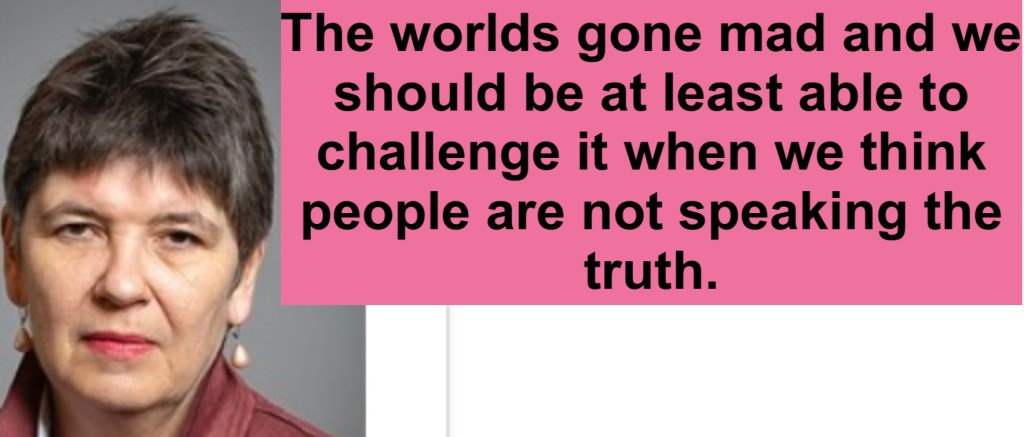
Claire Fox: The worlds gone mad and we should be at least able to challenge it when we think people are not speaking the truth.

You can support my work by a paid subscription to my substack or a donation below. All donations are gratefully received and help to cover my costs and keep my content open.

My Substack

Researching the history and the present of the “transgender” movement and the harm it is wreaking on our society.

£10.00

Women’s Equality Party: 4

The expulsion of Heather Brunskell-Evans.

This is the fourth post on W.E.P following their vote to accept men who self-identify as women. You can read the series here: 👇

Women’s Equality Party

This one will focus on an episode of the moral maze, from 2017, which BBC licence holders can listen to here: 👇

Moral Maze November 2017

This was the Composition of the panel:

These were the witnesses who were called :

Part two covered Fae and Caspian and part three covered Stephen Whittle. I decided to devote an entire another post to Heather.

Buerk introduces the final witness, Dr Heather Brunskell-Evans, a research fellow at Kings College London, author of the book Transgender Children and young people (image below) Buerk adds that Heather is a feminist campaigner and then launches into questions,

Buerk notes that the “trans lobby” calls Brunskell-Evans a “terf” , a trans-exclusionary, radical feminist and adds “What does that mean and why don’t they like you?”.

Heather responds by explaining that this term is perjorative and that she is not alone in attracting the slur, “terf”; it is applied to anyone not accepting the “trans” doctrine. She also points out that she does not exclude anyone and is comfortable with people claiming the identity of “trans”. Heather also points out that the book 👈 is jointly edited by Professor Michele Moore.

(I have seen Moore talk live and also her WPUK talk. If you have not seen this talk, by Moore, I can highly recommend it : 👇

Michele Moore

Mona Sidddiqui then asks “Why do you think so many, liberal minded, progressive, young people are buying into the “transgender doctrine” as you put it?” (Loaded question). Heather responds that she actually finds transgender doctrine reactionary, that both girls and boys should be allowed to dress how they wish but what we are witnessing is a new social narrative around gender non conforming behaviour that says if a boy likes to wear dresses he is literally a girl. Mona then asks what if it is more than that and the boy says he doesn’t feel right in this body? Brunskell-Evans says a genuinely progressive society a boy should be allowed to display gender non-confirming behaviour in the body he is in. These children have always existed but we are developing a new language to describe them. (Siddiqui repeatedly tries to interrupt and speak over Heather but she persists.

Mona now asks :

Heather can be heard disagreeing with the claim that the phenomena of the trans-identity emergin in the last ten, twenty years. The “transgender” child is most definitely a recent invention. I think Professor Siddiqui is confusing people with disorders of sexual development with people who identify as “trans”.

Heather agrees that people need rights but Siddiqui makes the counter argument that Heather is constraining those right by saying a boy who likes to wear a dress should not reassign his body. Heather responds by saying we should be allowed to be as we wish without making it a problem of the male body or the female body; Telling a small child that there is something not quite right with its body it’s actually got the brain of the other sex creates a harmful narrative and it’s actually abusive.

Now Matthew Turner. This question would have been an excellent question to ask of the “trans” identifying witnesses but, instead, he asks it of Heather. (Turner is the CEO of the NHS Confederation now which is an interesting move from the Royal Society of Arts.)

Turner gets Heather to agree with the premise of alleviating human suffering and then makes this, astonishing, pronouncement. The policing of women’s bodies and the rigidity of beauty standards, for women, are worse now than I have ever known. He has no idea!

Heather interjects to point out that we always make choices within social norms.

Ah, I see where he was going with this. He thinks that the social norms don’t dictate that men have to be “masculine” and women “feminine” so if people still feel their body doesn’t align with their “gender” surely they should be allowed to align their body with their “gender”. Yet he doesn’t see that both boys and girls are being told that if they don’t conform to the Barbie or Ken mode of being they might just be “born in the wrong body”. He has no idea!

Heather responds to say that the problem with this debate is people are categorised and pro-trans or anti-trans. Heather emphasises that Adult’s should be free to claim a personal identity but the problem is we are extending this to children. We need a public debate and an examination of the “science” ; especially claims that there are male brains and female brains.

Matthew then asks her to specify the age at which a person can make these choices. Heather refuses to provide an age. She reiterates that the kind thing to do is to allow the child to experiment with their identity but it’s incumbent on adults, who are responsible for the child’s welfare not to go along with the narrative (that they could be born in the wrong body).

For the views expressed in this interview Heather was reported to the Women’s Equality Party and subjected to a three month long investigation. Here is the list of allegations.

The identity of the complainants is kept confidential but one member did comment on a Women’s Place U.K. meeting at which Heather spoke. Many of us have had abuse from this individual. Toni is a late transitioning, married, heterosexual man; who calls himself a “Lesbian”. Something tells me he is an Absolutely Genuine Person or AGP, for short.

I assume this is the WPUK event in question.

Heather at WPUK

The Women’s Equality Party upheld the complaints and stripped Dr Brunskell-Evans of her party role. She left the party as many of us did. You can read her own account here 👇 and you will also find a wealth of information on her website.

Open Letter

I will do a round up of the panel’s deliberations in a final post.

You can support my work by a paid subscription to my substack or a donation below. All donations are gratefully received and help to cover my costs and keep my content open.

My Substack

Researching the history and the present of the “transgender” movement and the harm it is wreaking on our society.

£10.00

Women’s Equality Party: 3

The expulsion of Heather Brunskell-Evans.

This is the third post on W.E.P following their vote to accept men who self-identify as women. You can read the series here: 👇

Women’s Equality Party

This one will focus on an episode of the moral maze, from 2017, which BBC licence holders can listen to here: 👇

Moral Maze November 2017

This was the Composition of the panel:

These were the witnesses who were called :

Part two covered Fae and Caspian and in this one I will cover Stephen Whittle. I had intended to get to Heather’s contribution in this one but my ghast was so flabbered by Whittle I decided to devote the entire another post to her. I will give Brunskell-Evans a post to herself.

Stephen Whittle is a trans-identified female, Professor of Equalities Law at Manchester Metropolitan University, and quite a key figure in the promulgation of “transgender” ideology, in the U.K. Unsurprisingly they have cropped up quite a few times in my research. You can read my previous coverage here: 👇

Stephen Whittle

Whittle is introduced by the presenter, Michael Buerk, who then precedes to talk about males and females having different brain architecture and he asks Whittle how this squares with “his” claim that gender is a choice. Whittle begins by saying that “if you had said twenty years ago it was impossible to tell who was a man or a woman, everybody would have agreed with you”.{I don’t think this is what Whittle meant to say, from the subsequent comments I am going to assume that she means people would have agreed male and female brains are indistinguishable.}. Whittle continues by talking about new research that has discovered that the “transgender” brain is more aligned with the sex they identify “with”. In fact the jury is very much out on this point. The early post-mortem research failed to control for homosexuality, the impact of neuroplasticity, on a developing brain, or even the impact of the cross sex hormones. For an excellent thread on studies re brain sex, this thread is well worth a read and a follow, if on twitter.

Brain Sex

Leaving that to one side Whittle then says the brain sex argument is irrelevant to them because, as a lawyer, their only concern is with people’s rights.

Buerk hands over to Claire Fox who begins by expressing her bemusement at the male singer, Sam Smith, who is now a they/them and seems to associate females with sex (ist) stereotypes. This is a sample of Sam Smith’s idea of what makes him partly male and partly female.

Claire asks if Whittle understands why feminists are concerned that transgenderism is defining women by the trappings of femininity, which many women gave up a long time ago. Whittle responds with “Absolutely” and expands the answer below: 👇

This really doesn’t answer the question, to me. There argument is that there is a distinction between gender and gender expression, for “trans” people. This makes sense if we talk about how your sex doesn’t mean to have to dress like Ken /Barbie. Yet, for many “trans” people it seems perfectly clear they think “gender expression” = “gender”. This is what Sam Smith is doing. Yet we are also told we should not make assumptions about someone’s “gender” by the way they express themselves. This is why we have the acronym 0ET (zero effort trans) where a man with a beard has no shame about going on dating apps as a “Lesbian”.

Claire Fox then asks Whittle about the rapist Martin Pontin, who raped two sixteen year old girls, then identified as Jessica and was moved to a women’s prison as well as male pupils identifying as “girls” and demanding/ being alllowed to use facilities with girls.

Here is some background on Pontin. 👇. This is a picture of him.

As of 2022 it now emerges that Pontin has been granted a gender recognition certificate. Once again he got a GRC under the existing process, not the proposed self-identification route. This is what we must repeal the Gender Recognition Act.

This was Whittle’s response. Notice even Whittle can’t bring herself to say “she” and “Jessica”.

Whittle then proceeds to say countries who have introduced self-id have not seen any problems, listing Ireland, Malta, Norway and Denmark.

On Ireland 👇

Barbie Kardashion

On Norway

Christine Ellingen

It’is worth noting that Malta has some of the most draconian abortion laws in the world, not even allowing them to save the mother’s life.

In Denmark, in 2017, rape victims had to prove they had resisted to stand a chance of a conviction because rape was not defined by the absence of consent, there had to be additional, demonstrable “force”. Spousal rape was also only criminalised in 2013. Also, I give you Ibi-Pippi, legally a “woman”

Whittle finishes with this.😳 A cavalier disregard for the safety of women and girls. Heinous.

Ann McElvoy: “As a trans man are their any rights that you think you wouldn’t have, or shouldn’t have, that a biological man would have?”

Whittle can’t think of any rights he shouldn’t have, or doesn’t have that a biological man has. She then adds that they wouldn’t, at this stage of life, use women’s spaces. This is because they recognise that “whilst I may not be a man in the same way as my brothers I am no longer a woman in the same way as the women who use women only spaces”.

Ann McElvoy Do you think therefore that you should back off from that argument because one of the contested areas, particularly with feminists, or the most vocal feminists, has been about that space and who has the right to occupy that space, whether it is a lavatory or a changing room, places that are reserved for one or the other sex. You are challenging that idea and, at the same time, you are saying well I would actually stand back from it. I don’t think it’s right for me”

Whittle then decides there’s a huge difference between women only spaces and lavatories and changing rooms and, then seems a bit rattled “Oh for Christ’s sake we should all be able to go to the toilet in peace and quiet and privacy” . She then says all we need are decent locks and respect. After this Whittle turns the argument to focus on gender neutral facilities and claims they have been introduced at Manchester Metropolitan University and there have been no issues.

McElvoy then points out the inherent difficulty with self-identification because if you declare yourself to be the opposite sex you are mandating that everyone else has to go along with it. She then asks if Whittle sees any space for disagreement?

Whittle starts by saying they accept disagreement having lived with it for the whole of her life. She also says that she is not telling other people how to live their lives. (Hollow Laugh).

Whittle closes by saying that one of the problems is that “this has been medicalised before” (I assume she means being “trans” should not depend on hormones and surgeries).She also agrees with James (Caspian) that being “trans”is not diagnosable, it’s something that people do. Except Whittle doesn’t think you should have to “do” anything. It’s a shame the interview ended there because there is a lot to unpack here.

Firstly Whittle is imposing their way of life on the whole of society. She is in favour of any man identifying as a “woman” irrespective of surgical status (that’s the bit about “medicalising” gender dysphoria). She is also mandating that we accept those men in our spaces. That’s her dictating to women to accept dick in our spaces. Many of us don’t want any men in our spaces irrespective of their bodily modifications but Whittle doesn’t think you should have to “do” anything, other than declare your “identity”.

I will break off here and cover Heather Brunskell-Evans’ contribution and the panel conclusions in my next piece.

You can support my work by a paid subscription to my substack or a donation below. All donations are gratefully received and help to cover my costs and keep my content open.

My Substack

Researching the history and the present of the “transgender” movement and the harm it is wreaking on our society.

£10.00

Women’s Equality Party : 2

The expulsion of Heather Brunskell-Evans.

This is the second post on W.E.P following their vote to accept men who self-identify as women. You can read part one here:

Women’s Equality Party: R.I.P

This one will focus on an episode of the moral maze, from 2017, which BBC licence holders can listen to here: 👇

Moral Maze November 2017

This was the Composition of the panel:

These were the witnesses who were called :

I will cover Fae and Caspian in this one and cover Whittle and Brunskell-Evans in the next one.

Quite a good introduction from Buerk recognising the exponential growth in referrals to the Tavistock, including children as young as three. He also asks if medicalising identity is solving a problem or creating one? He covers the issue of what accommodations are asked of the rest of us and whether that should compromise single sex spaces including NHS wards and Rape crisis centres etc.

The presenter first turns to the only person “who identifies as male”, ‘as introduced by Michael Buerk, Matthew Taylor. At the time he was chief executive of the Royal Society of the Arts. (R.S.A). he is now Chief Executive of NHS Confederation. He was formally head of Labour Party Policy unit under Tony Blair and worked at a left leaning think tank. This is his opening position.

Next up is Claire Fox who is perfectly fine for people to identify however they wish providing the rest of us are not forced to go along with it. She does worry the tyranny of coercing people and institutions have to go along with subjective beliefs about oneself. Fox also worries that this may be a fashion rather than the historic issue of people feeling “trapped in the wrong body”.

Mona Siddiqui believes we should try to find a safe space for minorities, try to accommodate as far as possible, to allow people to make their own mistakes and to have the right to self-expression.

Ann McElvoyI think it is easier, in principle, to establish the right to self-identity which many liberals would support than it is to work out what follows from it” She goes on to say this is a social, clinical, psychological and medical minefield. She advocates for a need for a very careful examination of the issues and stresses the need to consider the ethical issues it raises.

“Jane” Fae

Buerk then introduces “Jane” Fae as a “trans woman”, using she/her pronouns, he also references Fae’s close relationship with the controversial charity Mermaids. (Today the Charity Commission announced a statutory investigation into Mermaids.)

You can read an earlier piece on Fae below:

Jane Fae: Trans Britain (Part 13)

Buerk uses the language of “transgender children” in describing the work of Mermaids, rather than a more neutral framing of children showing gender identity issues. His opening question to Fae is that, whilst we might have sympathy for adults, like Fae, we can also worry about the administering of, potentially, irreversible treatments to pre-pubescent children; while their identities might seem to be in flux.

This was Fae’s response to that question. This, by the way, is a blatant lie because by 2017 we had been administering puberty blockers, to children as young as 10, for over five years. Later he will acknowledge, and defend, the very real medical interventions happening to children.

Fae is then asked about becoming an activist, by McElvoy, and what moral lesson would he draw from his experience. {Fae seems suspiciously keen to shoehorn a mention to the panel that he had given a talk at the WOW conference (Women of the World). WOW was set up by Jude Kelly formerly of West Yorkshire Playhouse in case you wondered where she stands. Fae has been invited more than once.} He then claims he became an accidental activist; forced into it because of a need to discuss the finer points of legislation. He also bridles at the suggestion there is any “agenda” being pushed by trans activists.

McElvoy presses him about the age for medical intervention and says 16 still seems very young. She also mentions the sky rocketing of referrals to the Tavistock, Gender Clinic. Again Fae talks about children only being “socially transitioned”. McElvoy doesn’t let him get away with this and mentions delaying puberty being a medical intervention. This forces him to admit we are giving medical treatment. His new argument is that if we don’t block puberty and the child turns out to be “trans” we are setting them up for more medical intervention /surgeries to reverse the impact of this puberty. Asked about whether he agrees with “watchful waiting” Fae brings in the fact that we allow contraception and abortions based on Gillick competence and claims this is equivalent because we already administer hormone treatment to girls. {Note contraceptive pills are not the same as giving testosterone to females and there is no equivalent of the pill for male children.}

Claire Fox follows up be raising the issue of affirmative approaches to children, who claim a “gender identity” at odds with their biological sex, and asks why we validate gender identity but not, for example, an anorexic? He again claims we are only supporting the child but he then conceded that age ten puberty starts to have a major impact and it is clear he knows full well we are blocking puberty from that age. Fox also interrogates what support for a child might look like? Re-organising society for a child that thinks they are the opposite sex? Fae dismisses this. {Another lie, this is precisely what is happening, schools are instructed to let boys who identify as girls use female changing rooms and toilets and be address by wrong sex pronouns}.

Fae then changes the subject, to respond to McElvoy’s earlier point, about the exponential growth in referrals. Fae claims that nobody becomes “trans” they simply are “trans” based on the medical model of a “trans” identity. The idea this is a natural occurring mutation is hugely contested. I will just leave you with these statements by Andrea Chu 👇 and remind you that, as John Ozimek, Fae was a vocal defender of extreme porn.

James Caspian

Next up James Caspian, a psychotherapist, who worked with this group of patients for many years until he became concerned about increasing incidents of post surgery regret. This is his background.

Djordjevic had recently had seven people approach him to get “reversal” surgeries which had concerned him greatly. It was for this reason that Caspian wished to research de-transition but, as you can see above, Bath Spa University blocked this research, fearing backlash.

Matthew Taylor opens his line of questioning by asking Caspian to agree that the marginalised “trans” community, until recently, paid a huge price when they begin to identify as the opposite sex. Taylor’s point is that increased social acceptance has increased the numbers identifying as “trans”. (Caspian, though is talking about increased rate of regret, which, based on Taylor’s argument we would expect to see decreased). Caspian then talks about his shock at seeing the increased rate of teenage girls who regretted their bodily changes including mastectomy. Taylor’s rejoinder is to ask why Caspian had chosen to focus on this group.

Caspian explains that, in his two years of preliminary research, he found that the detransitioners he spoke to were wrestling with mental health issues, eating disorders, previous sexual abuse and their “transition”had not alleviated their issues. He also pointed out that those with autism were over-represented x 6, based on its prevalence in wider society. This is something widely known but nobody understands why this is the case.

Mona Siddiqui now asks what Caspian’s opinion is on the “right” reasons to transition. Caspian makes it clear this is a complex question. For this condition there is no diagnostic test and he points out this is the only condition where we perform surgery when no medical cause can be identified. It is diagnosed by a self-report from the patient.

First Do No Harm.

James gives an excellent clinician’s answers invoking his professional responsibility and that of the Doctors to “Do No Harm”. We are not just talking about someone’s “identity” but the medical consequences. He reiterates the amount of detransitioned femsles who deeply regret the hormones /surgeries they underwent and how easy it was to access treatments under the “affirmative model”. He then also points to a book Blood and Visions, about detransitioning, written by 10 females. I have not been able to locate a copy but this is the tumblr account which appears to be behind it.

Autotomouswomyn

I will break off here so that I have space to cover Stephen Whittle’s and Heather Brunskell-Evans’ contribution but also to look at the consequences for Heather and her own commentary on the experience.

You can support my work by a paid subscription to my substack or a donation below. All donations are gratefully received and help to cover my costs and keep my content open.

My Substack

Researching the history and the present of the “transgender” movement and the harm it is wreaking on our society.

£10.00