Parents of ”trans kids”: Puberty Blockers. Part 5

This is part six of a series looking at parents who all, bar one, believe they have a “transgender” child. Details of the funding are in part one. Oxford University is one sponsor. Mermaids are an advisor. Link to the series is here:

Parents of “Trans” kids: Series 2

This research is published on a website called healthtalk.org. You can find the link to this section here: 👇

Parents views on Puberty Blockers

What you will not find on the page about puberty blockers are the detailed, critical comments of one of the parents “Elijah”. This matters because anyone accessing this page will not see a parent detailing why he opposes puberty blockers or cross sex hormones, for under 18’s. I will insert his comments, in full, at the end.

Note that the web-site uses opposite sex pronouns throughout. I will not be doing so.

First up is repetition of the lie that puberty blockers merely ”pause” puberty and are reversible. The NHS, eventually, had to revise their guidance to explain that we are not clear of all the impacts of using puberty blockers. Sex hormones play a crucial role in brain maturation which continues to around the age of 25. Some known impacts, of puberty blockers, are lowering of IQ scores and negative impact on bone density.

It is also worth noting that some leading figures at WPATH have broken ranks, to sound a note of caution, over their use. You can read about this here:

Sloppy Care

Here is a clip from that piece. Taken from an interview with Abigail Shrier, author of Irreversible Damage.

Yes, you read that correctly “permanent sexual dysfunction”

Richard shares his thought processes about blocking puberty for his son.

Here he talks about the importance of timing of the intervention in relation to penis size. This is because the standard method of creating what is called a ”neo-vagina” which requires sufficient ”material” to invert for the surgery. {Anyone familiar with the poster child for puberty blockers, Jazz Jennings, will be familiar with the surgicalcomplications that followed because of his micro penis}. We start puberty blockers as young as age 10 in the U.K. It is estimated a penis reaches adult size between the ages of 18 and 21. The main pre-occupation in starting puberty blockers seems to be aesthetic, for males. For females early interventions seem less desirable, even adopting a ”trans-narrative” stance since they will stunt growth. Given that testosterone packs one hell of a punch on female bodies, even if taken later, it seems counter-intuitive to push early intervention in females, for reasons of ”passing”.

The parents all seem to believe they are simply giving their children time to think without the pressure of pubertal development. Unfortunately many clinicians believe it is the process of puberty that may resolve ”gender identity issues”. Blocking puberty may also be denying these children/teens any chance of a life without medical dependence. Also worth pointing out, to these parents, that at least 98% proceed to take cross sex hormones which suggests they don’t provide space for exploration but commence them on an irreversible trajectory.

One argument put forward for blocking puberty is to stop breast growth and thus avoid an unnecessary double mastectomy. Breast growth typically starts between the ages of 9-11 but it is not unusual for growth to start earlier. Here Georgina makes that argument. It is worth noting that many, maybe most, teenage girls struggle with their developing breasts and feeling “down” is not rare.

Oonagh is the one who introduces the idea to her son, who is pre-pubertal. Leigh is very certain that her son won’t change his mind but again peddles the myth that they merely provide “breathing space”. As I said earlier, at least 98% will progress to cross-sex hormones and will be sterile. Not infertile. Sterile. Children as young as 10 are taking this step, in the U.K, it is even earlier in the United States. Oonagh’s son seems unable to even utter the words ”penis” or ”testicles” using language which suggests a lack of maturity.

Here there is a short section on the consent process. Both parent and child signal their agreement to this process. This child has accessed blockers less than a year since “coming out”. 👇

The parents are, in this way, made complicit with the process. In an earlier piece I covered a Tavistock employee who explained why family involvement was important, from the perspective of the clinic. This is Dr. Aiden Kelly speaking publicly about why they involve parents in decisions about puberty blockers. Its because they don’t ”know” which ones will benefit, with any certainty.

Here Dr Kelly also admits they just do not have the evidence base and points out we don’t have any long term follow up.

You can read my full piece on Dr Kelly here:

Dr Adrian Kelly

Here is Leigh talking about her foster daughter, Now on hormone blockers. She describes the process for accessing them ”surprisingly smooth”. Later we will learn that the Social Worker colluded with this decision.

Ali is not happy at the amount of time it took to get her son on blockers.

Richard had some concerns about puberty blockers and the lack of long term data, his son, however, has now been approved to take them. He hopes the increase in “transgender” children will lead to more research. {Call me old-fashioned but should we not have the research before we massively increase the young people we medicate?}.

Elijah thinks the administration of puberty blockers is based on “bad science”. {Where’s Ben Goldacre when you need him?}?

Conversely, Mel felt the NHS were not ”trans-positive” enough. She feels the psychologists take a too questioning approach. Mel, however, is finding it necessary to develop strategies to cooe with the side-effects of the hormones.

I will leave you with Elijah’s critique of hormone blockers.

If you want to read more on puberty blockers, I did a series. You can access this here:

Puberty Blockers

You can support my work here. All donations gratefully received.

Researching Gender Identity Ideology and it’s impact on women’s rights, gay rights and the harms of the Gender medico-industrial complex.

£10.00

Parents of ”trans” kids. Part 4

Getting a referral to GIDs.

In this post I cover the parent’s thoughts on referrals to Gender Clinics. What is striking is the various ways children can be referred to the national, NHS, Gender Identity Development Service (GIDS) also referred to as the Tavistock.

You can access the rest of the series here, if you want to go through them in order: 👇

Parents of ”trans kids”: Series 2

I am particularly concerned at the presence of “educational professionals” on this list. I am not, however, surprised because so many of the Transgender Guidance packs also imply, or state, that teachers can be involved in referrals. This is not appropriate.

Some of the parents found the referral process quite easy but some encountered difficulties which are, variously, ascribed to ignorance, or prejudice on the part of the health professionals or other agency. Most were referred by the mental health services for children and adolescents (CAMHS). Many of the children were not originally referred to CAMHS because of gender identity issues, meaning they had pre-existing mental health issues.

Here Lesley explains that she felt her child’s issue was gender identity and why she instigated the referral to GIDs. Her daughter was struggling with self-harm and suicide ideation. Another parent had the idea suggested by the psychiatrist who was of the view ”the gender stuff was a big issue“. 👇

Parents were often very proactive in ensuring their child had a referral. Here the persistence paid off and, after a few questions and a bit of paperwork they achieved the desired outcome; referral to GIDs.

Not all parents had such a prompt referral and some were redirected to their own GP. Ali also complains that CAMHS then abandoned them after they were referred to GIDs, thus cutting off mental health support and, presumably, reducing the numbers on CAMHS books. I concur with Ali that a shortage of funds may have driven that decision.

Unfortunately this left a vaccuum and Ali’s child sought on-line support. Ali does not elaborate about the sources, or nature, of that on-line support.

Mermaids

Here is Georgina, who you may remember made a doctor’s appointment the very next day her daughter “came out”, she tells us how she immediately joined a support group on line. There she learned to get Mermaids involved in the event of any lack of GP Compliance. Note that description a ”non-compliant” GP.

She needn’t have worried the GP was co-operative. He did not query anything but he did caution her to tell the father, of the child he was referring to a gender clinic. Georgina had made a tick list of all the things she needed to do and telling the father “was the last person on this…list” . Even then the father was painted as a potential obstacle not an interested party.

Another parent reported that their GP said he had not encountered the issue before and asked them to come back when he had done some research. He soon got back in touch and acquiesced to the referral.

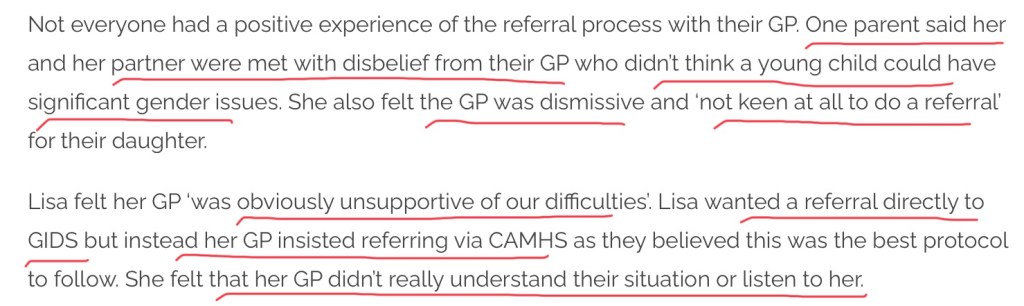
Lisa reported a less positive reception from her GP who insisted, quite rightly, on referring them to mental health services. She felt her GP was dismissive and didn’t listen to her.

However, Lisa did not take no for an answer and persevered. She provides a bit more information, below. She considered the GP ”uneducated” but because they ”knew their rights” he was coerced into making the referral. 😳

Another parent was similarly dismissive of the GP’s knowledge so she sought also sought advice from, controversial, lobby group, Mermaids. Clearly he would have preferred it to be taken to a panel for a decision.

This parent was also quite scathing about what she saw as a lack of knowledge from an experienced, and senior, GP. Personally, I wonder if he knows rather too much?

Another parent was prepared to go on the offensive to make sure she obtained the necessary referral. Once again Mermaids were called upon to get involved. Turns out GiDS are accepting referrals from a trans lobby group!

How times have changed?

This is going to be quite a lengthy series to give you some insight into the world of parents of ”trans kids”. How did we allow it to get so our of hand?

All my content is free but I have no income and rely on donations. You can support my work here.

Exposing the Gender Industrial Complex. The biggest medical scandal of this century. Any donations gratefully received.

£10.00

Parents of “Trans” kids: Series 2

Part 1. Who funds the research?

This series will look at a project featured on the website healthtalk.org. This project interviewed twenty families who believe they have been sent a ”transgender child” and some of the youth’s who identify as transgender. This series will look at the parents.

You can access the website here: 👇

Parents of “transgender” children.

Health Talks is run by a charity called Dipex.

The Chair of the trustees is a Professor of Medical Education. One of the other trustees is a Professor of Medical Sociology at University College London.

I have looked at the annual report and the accounts of associated companies. .There’s not much to share. They do say they have sister organisations elsewhere in Europe and the United States. I will research further if I track these down.

The research, I am looking at that was funded by the National Institute for Health Research, Nuffield Institute and the University of Oxford.

The people involved in the research project reads like a who’s who of Gender Identity Ideologues. Those of your who are not neophytes will know what to expect when I list the people credited on the website. Listed first is Lui Asquith of Mermaids a charity for ”transgender” children. Representatives of other “transgender” charities also appear. Jay Stewart from Gendered Intelligence, the Reedes from GIRES, a representative of the Proud Trust also appear. No list would be complete without a Stonewall representative and there is also someone from the Tavistock gender Clinic. Ruth Pearce is an academic and former colleague of Sally Hines, who has written a book on ”Trans Health” and is a trans-identified male.

Cal Horton is the researcher who also looked into this area; a non-binary parent with a ”trans child” and someone I covered in my series on the work Cal has published, on the same topic. (Quite possibly based on the same parents). You can read that series here:

Parents of ”trans kids”

Suffice to say, there were no skeptical voices involved in the research project.

As if that wasn’t bad enough they also sought input from one of the most misogynist trans-activists! More to follow when I start to cover the detail. It is worse than I anticipated.

I do this full-time and I have no income. If you can support my work it would be gratefully received.

Researching Gender Identity Ideology and it’s impact on women’s and gay rights. I have a particular concern about the medical treatment we are giving to children and young people. Many are gay, autistic or victims of child sexua, abuse,

£10.00

Parents of ”trans kids”: 2

This is the second piece on some research, for a PhD, on families in the U.K. who believe they have a ”transgender” child. Part One focussed on experiences with “socially transitioning” their child. It followed 30 families whose children ranged from years of three to eleven. Most identified as the opposite sex but some were ”non-binary”. For this paper the numbers under consideration were the 23 families engaging with gender clinics. As you can see from the title there was not much positive feedback about the gender clinics, in the U.K.

Full paper is accessible here:

Parents of “trans kids” at Gender Clinics

Broadly the parents felt the clinics were overly intrusive in their questioning /therapy and unsupportive of affirming parents. The social transition of children is a relatively new phenomenon, in the United Kingdom, and these parents, who have taken this step, are likely to be more convinced/entrenched in their belief system. The negative feedback seems very much driven by shock that the clinicians, at gender clinics, were still treating these children in an exploratory fashion. The parents have already determined that they had a transgender child on their hands and they did not take kindly to being questioned.

It also needs to be borne in mind that the author of the study identifies as ”non-binary” and also has a “transgender” child. Both the author and the parents spent time in closed groups for parents in the same situation; groups which cater for “affirming” parents. Parents who are more questioning are badged as ”trans-hostile” and were not included in the study, naturally enough as these parents are highly unlikely to be ”socially transitioning” their child. Of course this does not mean non-affirming parents are insisting only girls wear pink and have long hair. They may well have a son, like mine, with waist length hair and a penchant for perfume and baking. Like me they may be comfortable with this variant expression of masculinity and regard it as perfectly acceptable for his sex.

A central critique of the gender clinics is they are pathologising gender diversity because they are tainted by ”cis-genderism”. They are accused of seeking a “cause” for the “non-normative” development of the transgender child. By treating it as a disorder the clinics are, from the parents, they are erroneously seeking explanations rather than accepting the child as a “transgender child”. This is anathema to these parents who are firmly in the ”born this way” camp. It is necessary to understand the parental belief system to comprehend why they are so keen to embrace their ”transgender” child even to the extent of blocking puberty. For those of us who see embracing gender diversity as a positive value which does NOT , should not, include a drug regime, the parents embracing lifelong medical dependence are a baffling phenomenon. To ”affirmative” clinicians it is we who are problematic. To the author of this paper, clinicians who seek fo find an underlying cause for the ”gender dysphoria” are the ones guilty of “medical violence” . Yes by practicing therapeutic exploration you are accused of doing serious harm. The framing here is duplicitous. Parents resisting medical intervention, for our children, are perfectly accepting of diverse ways to express your ”gender”; we just don’t think society needs to medically intervene to mimic the opposite sex.

The author clearly believes therapeutic exploration is akin to ”conversion therapy” and any questioning induces feelings of shame and is a path to self-harm and suicide ideation.

The study then quotes some trans-ideolgues who rail against pathologising these children, instead they should be celebrated. Many /all of these parents fervently believe in this perspective. Is it any wonder, as we saw in part one, they feel they have no choice but to embrace their child’s ”identity”.

The results of the study were as follows:

Quotes from parents are included to illustrate the themes the author identified. We are told that many parents became emotional /angry when describing their treatment by the clinicians at gender clinics. One parent is aghast that the clinician wants to explore the impact of a still-born child on her/the family. Another that she was asked about the timing of the transgender identity in relation to the father leaving the family home. Another is unhappy the therapist wishes to explore the death of her mother and a second mother is unhappy the therapist wants to explore paternal bereavement:

The parents are manifestly irritated by the idea of any causal factor in their kids adopting a transgender identity. To them it’s all a waste of time. The child just is trans and all they really want is to take action; by which I assume they mean access puberty blockers. From this vantage point exploring issues like family break-up, sibling rivalry, bereavment or even whether they practice rigid gender roles, is irrelevant. There are plenty of quotes illustrating this perspective.

Another thing that comes over, very strongly, is the parents feeling let down by not encountering unquestioning acceptance of the trans-narrative; which is labelled “trans-positive”. More than one parent reports that a clinician had expressed a negative view about the parent having socially transitioned the child.

The way the parents interpret the exploratory therapy is akin to an inquisition. One parents talk about how they “wised up” to the direction they felt the clinician was heading by their line of questioning. It is clear to some of the parents that some clinicians see being ”trans” as a less than desirable outcome. While the clinician may have thought all parents would prefer an unmedicalised future for their child it is obvious this is not the desired outcome for these parents. They have already decided they have a ”trans” child and invested, publicly, in their child’s identity and see themselves as supportive parents. They talk of the hostility they face for socially transitioning a young child, some speak of unsupportive family members. Imagine arriving at a gender clinic and finally speaking to someone paid to understand this issue who does not immediately affirm your child! It clearly came as a shock. This was a really revealing quote from one parent. They had been ”excited” to visit the gender clinic and were left deflated..

Overall the assessment was that the gender clinics were judgemental and parents felt unnecessarily scrutinised. This parent expresses what seems to be the generally held opinion.

More than one parent complained that they felt de-stabilised by any questioning. Two are quoted rejecting clinicians who told them desistance rates for children with gender dysphoria were around 80%. This is based on a piece that looked at all studies conducted prior to early medical intervention. The fact these parents seem to prefer lifelong dependence on opposite sex hormones should have raised red flags all over the place. The author does raise child safeguarding issues but it is not for these parents, rather it is for parents who are not affirming. See this excerpt below: 👇. One of the recommendations is to educate the parents and if they do not get on board the clinician should take responsibility for prioritising ”child safety”. What form this will take is not spelled out but it all sounds rather ominous.

It is perfectly clear that these parents are very committed to the idea they have a transgender child. They do not want to be questioned lest they are dissuaded? The kind of ”care” which would seem to be desired is outlined by this parent: 👇

I will follow this up with a later post when the author publishes more of this research.

I do this work full-time and have no income. If you wish to support me you can do so here. All support is gratefully received but only if you have enough to spare. Irrespective my content will remain open access.

Researching Gender Identity Ideology and it’s impact on women’s and gay rights. I am particularly concerned about the medical transition of children and gay youth. I think this will turn out to be the medical scandal of this century.

£10.00

Bewley & Byng:

This is a paper from 2019. Raising concerns about the medical treatment used on children and adolescents with Gender Dysphoria. You can read it here: 👇

Bewley and Byng

The authors raise a number of concerns about the medical responses to children, and young people, with a Gender Identity disturbance. The paper covers the rising rates of referrals, minimal medical discussion and debate, reports of poor care and uncertainty around the evidence which is guiding medical practice. The authors also note the conflation of biological sex with social expectations associated with your biological sex; Gender roles.

BB884BFA-B1B9-4A73-ABE4-D0ED7E1BE589

The above is a neat summary of all the areas of concern. A specific concern is a move to an ”affirmative” care model. Broadly this approach argues we should not pathologise someone who believes they are the opposite sex, or neither sex, but should affirm that belief and facilitate, not gate-keep, access to medical treatment.

6F1BE36A-029C-4863-B299-A3B7A0EF7512

Rising rates of detransitioners is the predictable outcome. As covered in my series on Detransition. The authors highlight the changing landscape in terms of the rising rates of referral, the myriad of ”identities” claimed as part of youth subculture, and growing demands to have these identities affirmed via medical interventions. They also make that point that the GMC (General Medical Council) and the BMA (British Medical Association) adopt different positions.

A6C17B66-0165-482D-94A1-BA63A307EBA1

The paper consistently appeals for more knowledge in this area of treatment. The 4000% increase in females arriving at Gender Clinics should have aroused some, clinical, curiosity. The % increase for boys has also been in excess of 1000% over the same period which was roughly a decade. However the inversion of the sex ratio to 75% female should have warranted urgent attention. Here’s what Bernadette Wren (Of the UK Main Gender Identity Service GIDs /Tavistock) had to say to a parliamentary committee on this rise. This was in response to rising rates of referrals. Clip from Hansard. Note the ”we feel that we are at the cutting edge of a social revolution”

4A28BDB7-F93B-4DD5-B855-4F19D6305752

The impact of long term health outcomes is also a factor that will need to be taken into account when long-term testosterone use starts to affect the bodies of these girls/young women, the long term impact of blocking a natural puberty and the health consequences of surgeries whether or not they are regretted.

Continue reading “Bewley & Byng:”

Bob Withers. Part 5

This section looks at how young people are being misled into becoming lifelong medical patients. In this section the author looks at different scenarios based on fictional cases which, nevertheless, draw on real life cases from his therapeutic experience. I will add in some observations, from my own experience, of parenting a trans-identified son.

In this section we have some reflections on how our children come to share a belief they are born in the wrong body. 👇. These ideas are not emerging in a cultural vacuum. What shocks me, to this day, is the promulgation of this ideology by Childrens BBC. Programmes like ”I am Leo” were marketing this ideology to our kids. The main culprit, in terms of my son, was ChildLine, who are run by the NSPCC. For those who don’t know this is the National Society for the Prevention of Cruelty to Children, who are the only children’s charity to have statutory powers to intervene and ”protect” children. The NSPCC is deeply implicated in fostering a bodily disassociation as ”normal” to troubled kids who turned to them for help. {You can find my entire series on the NSPCC from the menu}.

Even purported academic/medical conferences are promoting this ideology and are even funded by the very pharmaceutical companies who stand to profit from our children’s distress. 👇 Big Pharma trumps talking therapies.

Bob then covers some of the common narratives of young girls, identifying as boys, who claimed to have spent time socialising with wolves, but this is not a social contagion, right?

He then covers the case of an autistic female who shed her feelings of “weirdness” when she identified as male. She resisted puberty blockers because of concern about the health risks. Finally she reconciled to her sex, and sexuality:

My son feels ”weird” about being a male, attracted to males, who enjoys female friends, likes to bake and was ostracised and subject to homophobic bullying from a young age. What is happening to him now is Gay Conversion Therapy. 👇. Whether intended or not this is the result of this, deeply homophobic, ideology.

The clinicans who are dosing my son with sterilsing hormomes are criminally culpable and I would like to see trials and imprisonment. Will it happen? I fear not because there are simply too many, high profile, people who have staked their reputations on defending the idea of “transgender kids”.

Next Bob looks at the TV show Butterfly in which Anna Friel plays the mum of a boy, Max, who feels as if he was meant to be a girl. Series advice was taken from the lobby group Mermaids. The Tavistock apparently withdrew their support for the programme.

This was from the trailer:

The programme foregrounds the idea of only two options. Allow Max to be Maxine or have a child suicide on your hands. Later they also dramatise the idea of a child attempting to castrate himself; all promote the necessary application of puberty blockers. The suicide data does not support these claims.


Bob then examines possible pathways for Max/Maxine. One of these is a non-medicalised future:

As in the ITV drama, Max could have a medicalised future as ”Maxine”. What could be the outcome? One outcome is pharmaceutical companies stand to make a lot of money. Once you start a kid on puberty blockers they, almost invariably, proceed to cross-sex hormones. He will be a lifelong customer.He will also be sterile. In the long term he will have a significantly increased risk of suicide. This is the only suicide statistic that trans-activists shy away from referencing.

Bob then looks at some other consequences. There are some knowns some unknowns. I impact on bone density is a known, impact on sexual function / ability to orgasm is a dirty secret which some, post-operative, males have reported.

One of the consequences of puberty blockers is stunted genitalia, for males, which complicates any future surgeries. Even with “successful” surgeries there are issues re ”maintaining“ a ”neo-vagina”.

After a reminder that Mermaids advised the series producer, and some skepticism about the picture painted in ”Butterfly”, we are presented with an alternative scenario where Max/Maxine gets some meaningful, therapeutic intervention. Eventually he discloses some child sexual abuse and his mother’s feelings about his “sexually predatory” father. Max begins to consider whether these things promoted rejection of his sexed body.

Like many detransitioners this costs him dearly in terms of his social networks.

Finally the author draws these conclusions. Affirmation relies on low quality research and the silencing of critical/questioning voices with cries of ”transphobia”.

Withers makes a final point about the societal response to ”Gender Dysphoria” and other mental health issues. Is it our own discomfort which drives us to accept a medical diagnosis and treatment pathway. Have we embarked on a programme of sexual lobotomy? “Surely this must suit us for some reason”

I am unwaged and cover this issue full-time. If you can support my work you can do so here. Only if you have spare capacity and, irrespective, my content will remain open access.

Researching Gender Identity Ideology and it’s harmful impact on women and girls and gay rights.

£10.00

Bob Withers: Detransition. Part 4

You can read the other pieces in this series below: 👇

Bob Withers: Series.

Detransition

This part of the paper covers the consequences of unthinking affirmation of a gender Identity which is at odds with their biological sex. The mistake we are making is written on the bodies of our young who are taking cross sex hormones and having unnecessary surgical procedures.

Writing in June 2020, Bob notes the increasing phenomenon of detransitioners. These are people who have had some medical intervention to resolve their distress, under the aegis of a transgender identity, only to realise they have made a catastrophic mistake. Gradually we are seeing more public accounts of detransition and some, scholarly, research. At the same time James Caspian has been denied the opportunity to research this phenomenon, at Bath Spa University, due to concerns about ”reputational risk”.

There is a lack of reliable data on rates of regret / detransition. The phrase ”loss to follow up” recurs in many studies which ought not to be a surprise. Why would you return to the clinic who are responsible for your ”transition” ? We have no way of knowing how many of the missing 36%, mentioned below 👇, also regret their medical interventions.

Another feature of this research is the way completed suicides are treated. There were three suicides in a cohort followed up from a Nottingham clinic. They were not counted as detransitioners but their subsequent suicide certainly does not suggest surgery was an unmitigated success.

The use of misleading statistics about suicide, especially in relation to children, is one of the most egregious tactics used by the Transgender Lobby. It is leveraged to encourage parents to accept a “gender identity” and hasten them to affirm /medicalise. Yet the same groups show a marked lack of curiosity about solid data on post transition suicide rates.

Despite the paucity of formal research there is a growing community of detransitioners who are finding each other in on-line forums, conducting their own research and making YouTube content about their regrets.

Detrans Community on Reddit:

Since this paper was written the detrans subreddit has exploded in terms of its numbers as per below. Since June 2020 the reddit detrans forum has increased from 12,000 + to nearly 26,000 as of February 2021.

I have done two substack posts covering comments by posters, on the above forum. Below is the one on males who regret their ”transition”.

Detransitioned males

This is one on detransitioned females. There are commonalities between the two groups but also some sex specific differences in both the reasons for medicalising their distress and their decision to detransition.

Detransitioned females

The above accounts need more formal research so that we don’t continue to harm a new generation.

Dr Az Hakeem: Trans


This piece by Bob Withers also covers the work of Dr Az Hakeem, who conducted therapy for men who regretted their transition. He provides many case studies in the book ”Trans”. There are many reasons this group are marginalised/silenced. Some are related to personal feelings of culpability and foolishness about the, irreversible, medical steps they taken. Backlash from within the trans community is another reason; many are accused of risking other, trans-identified, people’s access to surgeries etc. This can be very powerful deterrent if your community of friends is drawn from within transgender groups. Many detransitioners speak of losing entire friendship groups when they detransitioned, especially if they questioned transgender ideology.

Dr Hakeem had the inspired idea of setting up a group for those with post-operative regret. He writes about how many became fixtures of this group and how it allowed them to recover self esteem. Another practice was to run combined sessions for this group and the pre-surgical group. The second group were looking forward to medical interventions. So what happened when they mixed these two groups? 98% abandoned the idea of medical treatments for their feelings of gender dysphoria

The group who voluntarily referred themselves to Dr Hakeem were a self-selecting group. Its hard to argue they were representative but it is noteworthy that they were prepared to go back to the gender clinic and make their regret clear. It is odd that this didn’t result in more research and better follow up of their post-surgical clients. Even more odd is the fact we have actually lowered the bar to medical intervention, in recent years. Given the explosion of people with a ”transgender” identity and the average time estimated for regret to set in, what kind of situation will we face in a decade?

My fifth piece from this paper will explore how young people came to their belief in a personal identity as ”transgender”.

If you can afford to support my work you can do so here. Only if you have spare capacity. Any help gratefully received.

Researching the impact of Gender Identity Ideology on women’s rights and gay rights. In particular I ask questions about why gay, autistic and kids in care are over-represented at gender clinics.

£10.00

Bob Withers: Medicalising distress.

This is part 3 on an excellent paper by Bob Withers.

You can read parts one and two here:

Bob Withers: Series.

Why are we treating distress by blocking puberty, prescribing cross-sex hormones and surgeries? Not only are we ignoring the underlying issues we are creating new, medical, issues for this vulnerable group. Below are the kind of co-morbidities which exist within this group now labelled as ”transgender”. Underlying issues are left untreated by this rush to label these kids as “trans” and medicalise their distress. We have had medical fads before and are now, uncritically, assuming these psychological problems as the state of being ”transgender”. This is a label of convenience, which just happens to make pharmaceutical companies a lot of money.

This diagnosis is encouraged by trans-activists who believe they are supporting a new civil rights issue. Children are also being bombarded by trans-ideology by broadcasters, like the BBC and purported children’s charities like the NSPCC, via ChildLine. Our kids follow YouTube influencers and can easily find out how to access drugs by learning a script. The script may include invented childhood histories, real or claimed self-harming and suicide threats. These stories are replete with reinterpretations of the past and may include the phrase ”authentic self” accompanied by unverifiable claims to feel like the opposite sex. Using these phrases it is all too easy to obtain drugs from a credulous, or cowed, medical profession. These drug pushers have either imbibed the propaganda, or are operating a profitable sideline. A decade long campaign has removed any meaningful ”gatekeeping” , exposing our kids to having their bodies mined, for profit, by an unscrupulous industry. Finding a therapist who does not ”affirm” your child is nigh on impossible.

Big Pharma!

This is where it starts to get sinister. In the previous blog Pfizer pharmaceuticals were funding a conference hosted at the Tavistock gender clinic. Here we discover that Ferrings Pharmaceuticals are funding studies on the drugs they are making massive profits from!

I did a bit of digging on the Electoral Commission’s superb database. Heres the headline figure from donations made, by Ferring pharmaceuticals to the Liberal Democrats.

Here’s a screen shot of the list. That entire sum went to the LibDems!

Denton’s Document

Withers is referring to the Denton’s document, below, which outlines the strategy for making sure laws are passed to embed gender identity ideology in legislation. This document was a collaboration between a trans lobby group (IGLYO), the Thomson Reuters Foundation and the worlds largest law firm. I blogged about that, sinister, document here:

That Denton’s Document

Follow the money

He is not wrong about the profits to be made. This is just for puberty blockers. Note also that the courts shut down one profitable market, for corruption! Are our kids the new market? You, bet they are.

Consider the profits to be made by lifelong dependence on cross-sex hormones? Throw in the surgeries and look at the predictions from GM Insights. This tells investors where to head to make big money. You can read the preview of their report here: 👇

It’s an Industry


Here they project the compound annual growth rate (CAGR) of these surgeries. Anything above 15% is regarded as a good return. Government policy is integral to the growth of this “market”. We are fostering a bodily disassociative disorder for profit!

Here they are estimating the market. They are leveraging the distress of our youth for billion dollar returns.

They do bury this information in the footnotes.

A stark warning.

I will end with this blog with a chilling prediction from the author. My next piece will stay with this paper but cover the section on detransition.


I do this full-time and unwaged. If you are able to support my work you can do so here. All donations gratefully received. I am due a bill of £240 to renew this site.

Researching gender identity ideology and it’s harms to women’s rights and gay rights.

£10.00

Marketing the Transgender Child 1

In the past decade we have seen a viral marketing campaign to convince our children it is possible to be born in the wrong body. Given how many politicians, media pundits, academics and medical doctors have fallen for this, relentless, propaganda is it any wonder our young believe it?

The first example, on mainstream television, was I Am Leo. I still am shocked that BBC Children’s television pumped this out to our kids when we thought they were in safe hands.

I cannot do better than this guest post, via Transgender Trend so I will link this critique y Helen Saxby: Full article linked below and and excellent quote that summarises the problems with I am Leo:

I am Leo

The programme got a glowing write up by an organisation called the Children’s Media Foundation who boast influence with the All Parliamentary Group on Children’s media. Indeed the public inquiry contact for the APPG is a member of staff from the Children’s Media Foundation. At the time both John Nicholson and Connor Burns sat on this APPG, both have been particularly vocal on transgender issues. Phillip Pulman, another person in thrall to Transgender Ideology, was also a patron of the foundation.

They produced a year book in 2015 which, as well as an article by the head of children’s BBC, included an interview with the Cat Lewis, Executive Producer of ”I Am Leo”.

Cat Lewis was very proud of the fact this was the first programme about a transgender child to be broadcast in the U.K.

Cat Lewis talks candidly of the nervousness of the BBC when first pitched the idea. They were persuaded, in part, because Leo was already out in public and therefore the programme would not be revealing Leo as a female, in the media, for the first time.

The programme featured Leo holding the passport they had defaced for correctly recording her as a female. In a pattern I have come to expect, Leo had a history of being bullied. Leo was also supported by the Trans lobby group ”Press for Change”. So, not just a random kid of off the street.

Because Leo, we are told, had already been ”living as a boy” for some years (which appears to mean short hair, liking football and rejecting female sex stereotypes) the producer needed a different narrative arc. This turned out to be working with the Tavistock Gender Clinic to showcase the new treatment of blocking Puberty. This is the part with glaring inaccuracies. The series includes some cute graphics to illustrate the ”pause” and Polly Carmichael explicitly stating the following:

A statement somewhat at odds with a near contemporaneous statement made to the, putative, grown up media: “We don’t have the evidence”.

The show was a media success, garnering awards for the team, which is surely their raison d’etre and not the provision of accurate media portrayals for kids.

Alice Webb, of the BBC waxes lyrical about the role of CBBC in these clips from her interview, in the same document. How many parents knew that CBBC were pushing boundaries with our kids by feeding them the nonsense they can be born in the wrong body? She is proud of the role of the BBC in ”shaping” our kids’ lives. A grave responsibility which the BBC betrayed with this trans propaganda.

This is the first part of a series on the marketing of the Transgender child, Its just product placement at this point.

You can support my work here, if you are able.

Researching the impact of Gender Identity Ideology on women & girls as well as the consequences for Lesbians, Gay males and autistic kids. I do this full time and have no income. All my content is open access and donations help keep me going. Only give IF you can afford. Thank you to my generous donors.

£10.00

Butler & Hutchinson: Detransition

Part 6.

This paper was referenced in part 5 of this series. You can read part 5 here: 👇

Detransition 5

PDF of the paper below: 👇

butler2020

The paper was published, in November 2020, in the Journal for Child and Adolescent Mental Health.

BBC091B5-F304-4FA2-B54F-7C081BC584BC

FB5BF794-D70D-4E37-8AD9-D9FE07442F1A

This paper is jointly authored by Anna Hutchinson and Catherine Butler. Dr Butler is an academic, based in the psychology department, at Bath University. Dr Hutchinson has impeccable academic credentials and has held senior, clinical, posts including a stint at the Tavistock centre. 👇

LACK OF DATA:

The common theme in all the pieces I have done, on the topic of detransitioners / desisters, is a lack of current data. Desistance rates have, historically, been found to be as high as 98% for children who present at Gender Clinics. Even a desistance rate of 85% should call into question the practice of giving Puberty Blockers to children. Which, let me remind you, in the United Kingdom, are given to children as young as 10.

B4F95D36-D87D-4248-A3AE-A0FCC234017B

We also know that over 98%, of children, given puberty blockers, progress to cross-sex hormones (CSH). This suggests we lock these kids into a medical trajectory. Trans-activists argue the near ubiquity of progression to cross sex hormones is evidence of solid diagnostic criteria; which I find implausible. Here a Clinician, from the Tavistock, admits uncertainty adding that this is why it is important to get the parents to take responsibility for putting a child on puberty blockers. 👇 ”Because we dont have the evidence base” . {Dr Aiden Kelly}.

4D5FF3F8-F70A-4D70-9460-5AECD4F3223F

The near certainty these kids will progress to CSH also undermines the argument that blocking puberty allows a ”pause” for the child/family to weigh up their options.

Detransition Denial.

Rising rates of referrals to gender clinics is a worldwide phenomenon. There is also a concomitant rise in detransitioners. At the same time there is a widespread reluctance to acknowledge desisters/ detransitioners. The authors speculate, correctly in my view, that the dismissal of detransitioners’ testimony is driven by fear; a fear their stories delegitimise medical responses to Gender Dysphoria. This, I would add, threatens the profits of the Gender Industrial Complex. Suppressing information about post-transition regret, in this cohort, distorts the evidence available to judge the success rates of medical transition. It also doesn’t allow for any, evidence led, improvement in diagnostic criteria by identifying commonalities in the detrans community.

Furthermore disregarding detransitioners means medical professionals are poorly equipped to deal with regret. There is currently no guidance to address the consequences of post ”transition” regret; whether psychological or medical.

C5473C38-4E46-4CB2-9AC0-9C3257940272

GENDER JOURNEY:

Despite the reluctance to acknowledge this community it has become increasingly difficult to deny post-transition regret. Some transgender activists now, implicitly, acknowledge the phenomenon but claim this is all part of a “Gender Journey” . This paper uses similar language, below, calling it a “development trajectory”. I am extremely wary of this framing which smacks of spinning regret for public relations purposes. It is, nevertheless, the case that some detransitioners say they may have been left with doubts had they not tried medical transition. However, we shouldn’t discount the possibility these responses are driven by a, subconscious, desire to salvage something positive from the experience. Either way I think we need to be cautious about this language which may serve to mask bad diagnostic techniques and normalise regret as an acceptable outcome.

HOMOPHOBIC BULLYING:

As with the other studies I have reviewed, the experience of homophobic bullying is identified as a factor leading to adoption of a trans-identity. We could see this as a mal-adaptive coping mechanism. The other recurrent themes are isolation; poor peer relations and family difficulties. Factors which appear related to desistance also recur. Understanding commonalties in desisters could also assist with better screening of those who present at gender clinics. This cautious approach has been cast aside with the current ”affirmation only” policy; which is being rolled out in new pilot clinics under this government.

0F6F88E8-7A7E-47C1-8D78-DE9511B6A796

The authors are keen to highlight research that stresses the importance of family support for “transitioning” . They also suggest the corollary can be feelings of shame, if the outcome is regret and re-identification with birth sex. In fairness parents, like me, who think our teenagers are making a mistake, may find our children are similarly inhibited from expressing regret. There is a natural reluctance to confirm your parent’s were right and admit you made a mistake.

11AFB54C-575F-406E-9314-B16E8DCD52AC

The authors point out the development of diagnostic criteria, for children, is a relatively recent development. This allows trans-activist to argue earlier cohorts may have swept up children who were merely ”gender non-conforming”. This argument is used to dismiss earlier research, showing high rates of desistance, as historic failures in diagnosis. Trans-activists argue that diagnostic techniques have improved and earlier data is not relevant to the current cohort. I am cynical about this argument.

86AA3112-1004-4C4C-A53D-243C3492D499

LOSS TO FOLLOW UP:

Some key themes about difficulties with research on detransition are covered below. Those who regret the treatment they received are less likely to return to the clinic who they may feel harmed them. Loss to follow up is a major stumbling block to getting accurate data. Worryingly the length of follow up times is quite short. If, as Dhejne says, we are looking at an average of eight years, before regret emerges, we are only at the beginning of this wave of detransitioners. Given there are already over 23,000 in the detrans reddit forum that is horrific to contemplate.

D1E5090C-5D8A-41A9-BDD7-A8CAE5D7A966

CHANGING DEMOGRAPHICS:

This section is critical in understanding the changing demographic referred to Gender Clinics. The scale of referrals; increase in females; emergence of different types of identities; the impact of socially transitioning children as well as the phenomenon of teenage onset gender dysphoria are all salient factors.

D74D9F63-BB75-41CD-A510-E03654471878F2F50147-A20A-4913-80B8-10811495D381

Our understanding of the above phenomena is limited and yet clinical practice has embraced an affirmation model with seemingly little reflection.

AUTISM & HOMOSEXUALITY

Autism and same sex attraction are features of the current, young cohort and we should all be heartbroken so many don’t feel comfortable with their homosexuality. It is for this reason that I describe what we are doing as a from of Eugenics/Gay Eugenics.

9A7D50A0-FC53-4FA3-8B92-D4D0264B99C2

Clinicians will need to develop a whole range of different skills to deal with the emerging cohort of detransitioners. Some may have undertaken medical treatment which means they can no longer produce the appropriate hormones for their sex. Young women who can no longer have children may need counselling. As covered in my previous piece many detransitioners were very critical of the inability of psychologists and doctors to address their needs.

272C775F-E853-4104-AD3E-CD4E262D330B

I doubt a young man who emerges with no testicles/penis or a female with no breasts/womb would regard this as a period of creative exploration. 👆

The advice below is likely appropriate for therapeutic approaches to working with clients. I also argue, we should be extremely wary of introducing permanent, medical intervention whilst, simultaneously, paying lip service to the idea of ”gender fluidity”.

88557547-E3AA-48C6-B35C-07A29D81DED5

I also object to the idea that we accord the description of ”acceptance” to the families going along with the idea our children should become medical patients for life. The parents who are supportive of our gay offspring, and their variant expressions of masculinity /femininity, are the ”accepting” parents.

The paper presents some practical advice for clinicians who are increasingly likely to encounter detransitioners. I would add that doctors who have prescribed treatments, which have resulted in regret, will need guidance and support. They may be defensive in their response to detransitioners who could be very angry. Detransitioners have identified peer support as invaluable and clinicians need to be aware of the networks available.

3A9BA7B0-9910-470B-8F46-6CF813C0B7EB

The themes emerging from the growing body of research on detransitioners make it clear we need to start looking critically at medical responses to a psychological phenomena. We should stop normalising permanent dependence on synthetic hormones/ surgery on healthy bodies. We need to face up to the real regret we are seeing and stop cloaking a medical scandal in the language of ”Gender Journey” or using phrases like ”creative exploration”. If gender is fluid why are we accepting permanent interventions for children and teens?

Guilting families into going along with this by applying the term ”acceptance“ to “affirming” parents is emotional blackmail. How is agreeing your son /daughter needs hormones and surgery, to be authentic, acceptance? Surely it is the exact opposite?

CONCLUSION:

We need more research to better predict outcomes and develop guidance so clinicians know how to deal with the needs of detransitioners. Work to understand this new demographic is still in its infancy. Once doctors have to face the consequences of post transition regret maybe this will re-engage their critical faculties. Right now I see only reckless endangerment.

D3B09807-62D7-41E8-A997-B28A64A8CDEE

I do this full-time and have no income. If you want to support my work, and can afford to do so, here is one way.

Researching the impact of Gender Identity Ideology on women & girls as well as the consequences for Lesbians, Gay males and autistic kids. I do this full time and have no income. All my content is open access and donations help keep me going. Only give IF you can afford. Thank you to my generous donors.

£10.00